
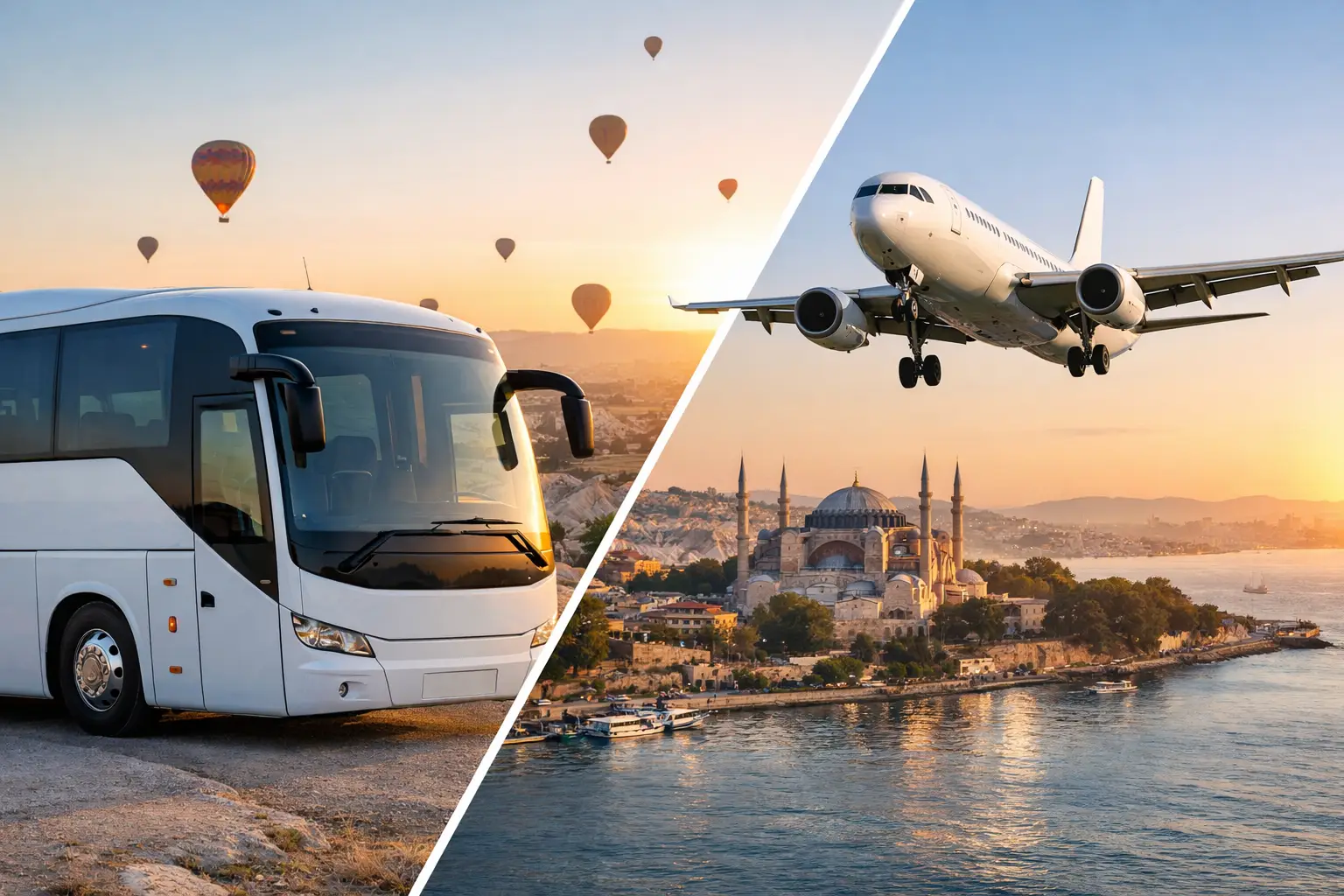
Landing in Istanbul and trying to connect the rest of your itinerary is where the Turkey bus vs flight question becomes very real. On paper, both work. In practice, the right choice depends on how much time you have, which regions you want to combine, and whether you want your trip to feel efficient, scenic, or deeply comfortable from one stop to the next.
For most international travelers planning a multi-city journey in Turkey (Türkiye), flights make the biggest difference when distances are long and vacation days are limited. Buses, however, still play a useful role on certain routes, especially when you want direct overland travel without airport formalities. The smartest itineraries often use both, with private transfers filling the gaps so the trip feels smooth rather than pieced together.
Turkey bus vs flight for popular routes
Turkey is a large country, and the distance between headline destinations can surprise first-time visitors. Istanbul to Cappadocia, for example, is not a short hop by road. The same is true when connecting Istanbul with Ephesus, Pamukkale, or Antalya. If your goal is to maximize sightseeing time, flights usually win on these longer segments.
The difference becomes clearer once you map out a classic route. Many travelers want to combine Istanbul, Cappadocia, Ephesus, and Pamukkale in one trip. Add the coast or a blue cruise, and every transfer starts to matter. A domestic flight can turn a full travel day into a manageable half day, leaving room for a sunset in Cappadocia, a guided walk in Ephesus, or an extra night at a boutique cave hotel.
That said, bus travel is not automatically the wrong choice. On some regional routes, especially where the road journey is straightforward, a well-timed bus can be practical. If you are traveling between nearby destinations and do not want to deal with airport check-in, road travel can feel simpler. It just requires a realistic view of travel time.
When flights make more sense
Flights are usually the better option when your itinerary includes major jumps across the country. Istanbul to Cappadocia, Istanbul to Izmir for Ephesus, or Cappadocia to Antalya are the kinds of routes where flying protects your schedule and energy.
This matters even more on tailor-made itineraries built around key experiences. If you want a full-day Istanbul tour, a dawn balloon morning in Cappadocia, and then a smooth move on to Kusadasi or Selcuk for Ephesus, flights help keep those experiences intact. You spend less time in transit and more time where you actually came to be.
Comfort is another reason many travelers prefer flying. The flight itself is short, and with the right airport transfers and domestic flight planning, the entire journey feels controlled and predictable. For couples, families, and private travelers, that can be worth far more than the fare difference.
There is also the issue of arrival quality. Reaching Cappadocia after a short flight and transfer is very different from arriving after a long overnight road journey. If your next morning includes sightseeing, a private tour, or an early start for balloon viewing, arriving rested is part of the experience.
When bus travel still works well
Bus travel in Turkey has a long history and remains widely used. On the right route, it can be a reasonable option, particularly if you prefer point-to-point travel by road and are not trying to cover too much in a short trip.
The strongest case for a bus is when the journey itself fits comfortably into the day and does not interrupt the flow of the itinerary. Some travelers also enjoy seeing the changing landscape, especially when moving between regions with open countryside and smaller towns along the way.
Bus travel can also work for guests who want to balance premium experiences with selective overland segments. For example, you may choose to fly the longest route, then use a road transfer or bus for a shorter connection before continuing with a private guided program. In these cases, the key is coordination. A disconnected transfer plan can make a well-designed trip feel tiring very quickly.
Time vs comfort vs flexibility
The best answer to Turkey bus vs flight usually comes down to three things: time, comfort, and flexibility.
If time is your priority, flights are usually the clear choice. This is especially true on trips of 7 to 10 days, where losing a full day to transportation has a real effect on what you can see. Many guests visiting from the US or Australia want to experience several regions in one journey, and air travel makes those combinations much more realistic.
If comfort is the priority, flights plus pre-arranged transfers are often the strongest option. You avoid long road hours and keep transitions clean. This works particularly well for private Turkey tours, honeymoon-style itineraries, and travelers combining cities, inland heritage sites, and coastal stays.
If flexibility is the main concern, the answer depends on how your trip is structured. Buses can offer straightforward overland access, but flights can also provide flexibility when paired with professional planning. This is where a local travel specialist adds value. Rather than choosing one transport type for the entire trip, it is often better to build the itinerary around the experience you want in each destination.
Route planning matters more than the transport itself
A common mistake is comparing bus and flight in isolation. What matters more is how the transport fits the overall route.
Take a classic cultural itinerary: Istanbul, Cappadocia, Pamukkale, Ephesus. If you try to do all of that mainly by bus, the trip becomes much more transit-heavy. If you fly strategically and use private ground services where they make sense, the same route feels balanced and comfortable.
The same idea applies to coastal extensions. Travelers often want to add Bodrum, Fethiye, Marmaris, or Antalya after visiting the inland highlights. A well-planned combination of domestic flights, hotel transfers, and selective road travel creates a far better rhythm than trying to force every segment into one format.
For blue cruise guests, this is especially important. If you are joining a gulet cruise from the southwest coast, your inland connections should be timed around embarkation and hotel stays, not just ticket availability. That level of coordination turns a complex multi-stop trip into something that feels easy.
Practical travel tips for Turkey (Türkiye)
For most first-time visitors, 8 to 12 days is a comfortable length for combining Istanbul with two or three additional regions. If you want Istanbul, Cappadocia, Ephesus, and Pamukkale, allow at least 9 days. If you plan to add Antalya or a blue cruise, 11 to 14 days is more realistic.
Spring and fall are usually the best times for multi-city travel in Turkey (Türkiye). April to June and September to October offer pleasant conditions for sightseeing, regional transfers, and coastal extensions. Summer works well too, especially for the coast, but transport planning becomes more important as popular routes and hotels fill quickly.
A strong travel route for first-time visitors is Istanbul, Cappadocia, and Ephesus with Pamukkale added in between or after. For travelers who want both culture and coastline, Istanbul, Cappadocia, and Antalya is another excellent combination. If you prefer a more relaxed pace, choose three main bases instead of trying to see everything in one trip.
The best choice for most premium travelers
For travelers who value comfort, organized logistics, and making the most of each day, flights usually offer the better foundation. Buses can still fit certain segments, but they are rarely the best primary strategy for a premium multi-destination itinerary.
The most successful trips through Turkey are not built around the cheapest transfer or the fastest transfer alone. They are built around how each move supports the overall experience, from your first days in Istanbul to cave stays in Cappadocia, ancient sites near Ephesus, thermal landscapes in Pamukkale, or time on the Turquoise Coast.
That is why many guests prefer a tailor-made plan that combines domestic flights, private transfers, hotel stays, and guided touring in one clear itinerary. Travel Store Turkey, for example, often helps visitors shape these route decisions early, so the journey feels well-paced rather than overpacked.
If you are deciding between the bus and a flight, think less about the ticket and more about the trip you want to have once you arrive. The best transport choice is the one that leaves you with more energy for Turkey itself.
0 Comment