

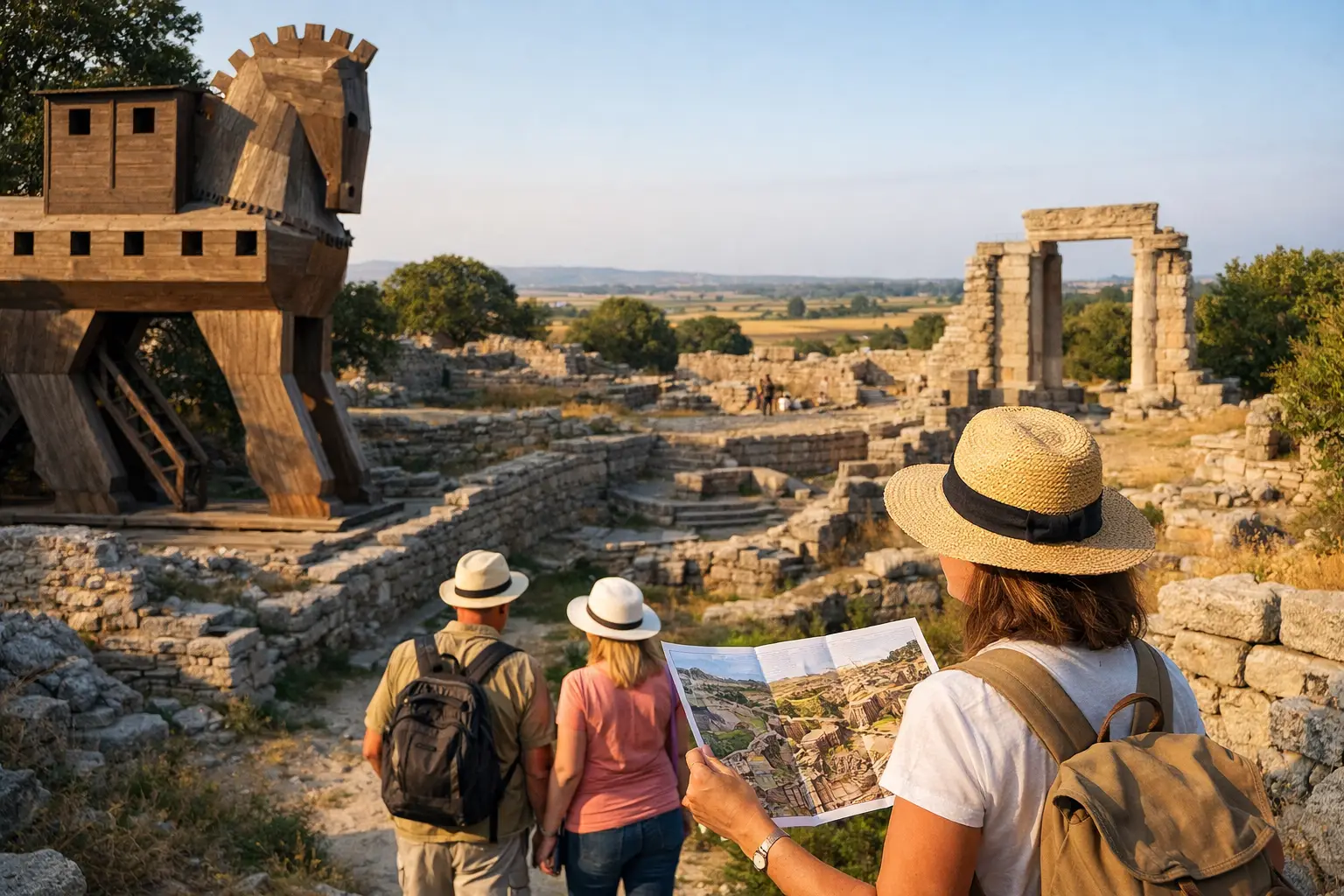
Troy Ancient City Guided Visit: What to See and How to Plan
The wooden horse may be the image most travelers expect, but the real reward of a
Troy ancient city guided visit
begins beyond it. On the hill of Hisarlik, near the Dardanelles, the remains reveal not one lost city but a succession of settlements built, destroyed, and rebuilt over thousands of years. Without knowledgeable interpretation, the stone walls can appear complex. With a licensed local guide, they become a clear and compelling journey through one of Turkey’s most significant archaeological sites.
For travelers who want to combine history with a well-organized route through northwest Turkey, Troy works especially well as a private day tour from Çanakkale or as part of a
two-day Gallipoli and Troy tour from Istanbul
linking Istanbul, Gallipoli, the Aegean coast, and Ephesus.
Why Troy Is Better With a Licensed Guide
Troy is not a reconstructed ancient city with intact avenues and monumental facades. Its importance lies in its archaeological depth. Several cities occupied this strategic hill over roughly four millennia, and their remains are layered one over another. A guide helps you recognize what you are seeing, which periods the foundations belong to, and why the site has remained important across so many eras.
The visit becomes much more meaningful when the route is explained in sequence. You may stand near fortification walls from the Bronze Age, see later Roman structures, and look across the plain toward the waterways that made this location valuable for trade and defense. The landscape is part of the story. Troy was never isolated—it was positioned close to routes connecting the Aegean world, the Dardanelles, and inland Anatolia.
A private guide also adjusts the pace to your interests. Some guests prefer a focused archaeological visit of two hours. Others want time for photography, the museum, and a relaxed lunch in Çanakkale. Families may appreciate a simpler explanation centered on daily life, legends, and the site’s famous horse. Travelers with a strong interest in ancient history can spend more time discussing excavation layers and the changing interpretation of the site.
What You Will See During a Troy Ancient City Guided Visit
Most guided visits begin near the entrance area and follow a walking route through the archaeological zone. The terrain is generally manageable, though there are uneven paths, stairs, and exposed sections. Comfortable walking shoes make a considerable difference.
The Defensive Walls and Settlement Layers
The early fortification walls are among the most memorable features at Troy. Their scale gives a sense of how seriously the settlement took defense and control of its surroundings. Your guide can point out the differences between the earliest communities and the larger, later cities built over them.
This is where guided context matters most. The site is not arranged like a museum display, and the remains do not always look dramatic at first glance. Understanding how the layers relate to one another changes the experience from a walk among ruins into a meaningful historical visit.
The Roman City of Ilium
Troy continued to hold cultural importance long after its Bronze Age period. During Roman times, the city was known as Ilium and received new public buildings, including a theater and odeon. These structures help visitors see that Troy had a long afterlife, shaped by the enduring prestige of its ancient past.
The Roman remains are also a useful reminder that Troy’s story is broader than a single legend. A well-planned tour balances the famous associations with the archaeological evidence and the many communities that lived here.
The Troy Museum
The modern Troy Museum, located close to the archaeological site, is strongly recommended for travelers who want a fuller understanding of the visit. Its exhibits provide historical context, artifacts, models, and visual explanations that clarify what the site itself cannot always show.
Including the museum is particularly worthwhile on a
guided Troy tour,
where the schedule can be arranged around your preferred pace. It is an excellent choice for guests staying overnight in Çanakkale rather than trying to fit everything into a long same-day return from Istanbul.
The Best Way to Include Troy in a Turkey Itinerary
Troy is often most enjoyable when it is part of a thoughtfully paced regional itinerary. Çanakkale is the practical base, offering a convenient location for visiting both Troy and the
Gallipoli Peninsula.
An overnight stay also avoids turning an important cultural experience into a rushed stop between long drives.
A popular route begins in Istanbul, continues south to Gallipoli and Çanakkale, then visits Troy the following day. From there, travelers can continue toward the north Aegean and İzmir before visiting
Ephesus.
This sequence suits guests who want to see Turkey’s major historical sites in a logical overland route.
Travelers comparing this route can review our detailed
Gallipoli and Troy itinerary for two days,
which explains how to balance the battlefields, Troy, museum time, transportation, and an overnight stay in Çanakkale.
The best route depends on the time available. With one week in Turkey, Troy can be combined with Istanbul, Gallipoli, Pergamon, and Ephesus through a carefully planned cultural itinerary such as our
6 Days Turkey Tour.
With 10 to 14 days, Troy can be included within a more complete
private Turkey tour
that also features Cappadocia, Pamukkale, and the Aegean coast. Domestic flights can save time on longer itineraries, while private transportation offers the freedom to travel comfortably between cultural regions.
For travelers who prefer fewer hotel changes, a tailor-made plan can combine flights and private touring. For example, you might begin with several nights and guided sightseeing in Istanbul, fly to Cappadocia for its valleys and cave hotels, then continue to the Aegean for Ephesus, Pamukkale, and Troy. The right arrangement depends on your arrival city, travel season, and how much time you want to spend at each destination.
Our
custom Turkey tour itinerary ideas
provide additional examples of how Troy, Gallipoli, Pergamon, Ephesus, Pamukkale, Cappadocia, and the coast can be combined without making the journey feel rushed.
Private Tour or Small Group: Which Fits Your Visit?
A small-group Turkey tour
can be a good choice for travelers who enjoy a structured schedule and shared experience. It usually follows a set route and works well when dates and sightseeing priorities are straightforward.
A private guided visit offers more control. You can select the pickup time, include the Troy Museum, stop for lunch where you prefer, and combine Troy with Çanakkale or Gallipoli according to your interests. This is especially valuable for couples, families, multigenerational groups, and travelers arriving from overseas who want reliable transfers and a clear day plan.
Travelers seeking a fully private journey can consider a
6-Day Private Turkey Tour
combining Gallipoli, Troy, Pergamon, Ephesus, Pamukkale, and Cappadocia with private transportation, expert guiding, and coordinated hotel arrangements.
Private arrangements also make it easier to accommodate travel pace. Some guests want a full day of history; others prefer to visit Troy in the morning and spend the afternoon along the Çanakkale waterfront. Boutique hotel options in Çanakkale can add an unhurried overnight break before the next stage of your journey.
Practical Travel Tips for Visiting Troy
The best months for a Troy visit are generally April through June and September through October, when walking conditions are pleasant and the Aegean landscape is at its most inviting. July and August can be warm, so an earlier start is advisable, particularly for guests who plan to visit both the ruins and museum.
Allow at least three to four hours for Troy and the museum together, excluding travel time. A focused guided tour of the archaeological site can be shorter, but allocating more time gives you room to absorb the setting and avoid rushing through the exhibits.
Çanakkale is the recommended overnight base. It offers straightforward access to Troy, approximately 30 minutes away by road, as well as a comfortable selection of hotels and restaurants. Istanbul can be used as a starting point, but a day trip involves substantial road time.
Travelers who have only one available day can still join a
Troy day tour from Istanbul,
including round-trip transportation, guiding, lunch, ferry arrangements, and entrance to the archaeological site. However, if Troy is a priority, an overnight stay in Çanakkale produces a more relaxed and rewarding experience.
Bring water, sun protection, and shoes with a stable sole. The site is open-air, and shade is limited in several areas. A light jacket can also be useful during spring and fall, especially near the Dardanelles.
Plan Troy as Part of a Well-Paced Turkey Journey
Troy deserves more than a quick photo stop. It is a place where archaeology, geography, and enduring cultural memory come together, best understood with an expert who can make the layers readable. When paired with Gallipoli, Istanbul, Ephesus, or a wider tailor-made route through Turkey, it becomes one of the most distinctive chapters of the trip.
Travel Store Turkey
can arrange a private or small-group itinerary with licensed guiding, comfortable transportation, hotel planning, airport transfers, and the right balance of destinations for your available days. Explore our
Turkey tour packages,
share your travel dates and priorities, and we can shape your Troy visit around the journey you actually want to take.
0 Comment