

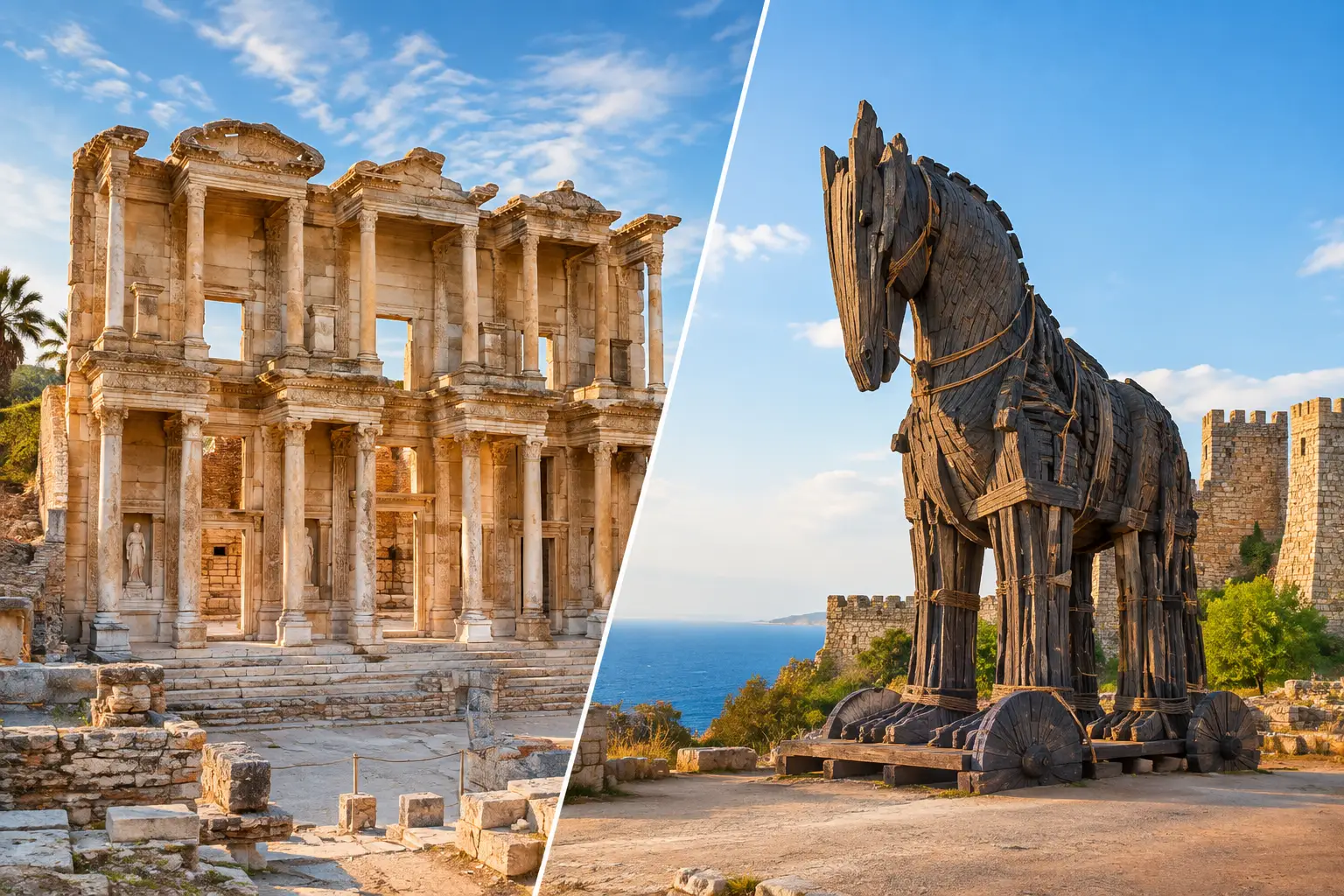
A choice between Ephesus vs Troy is really a choice between two very different kinds of ancient-world experience. Ephesus feels immediate and monumental: you walk along marble streets framed by grand public buildings, theaters, fountains, and houses. Troy is quieter, more layered, and more reflective, where successive cities reveal how a legendary place evolved across thousands of years.
Both belong on a well-planned Turkey itinerary, especially for travelers interested in classical history, archaeology, and the landscapes of the Aegean. But if time is limited, understanding their differences will help you choose the destination that best fits your interests, route, and preferred travel pace.
Ephesus vs Troy: The Essential Difference
Ephesus, near the town of Selçuk in western Turkey, is one of the Mediterranean’s most complete and visually impressive ancient cities. Its preserved streets make it easy to understand the scale of Roman urban life. The Library of Celsus, Great Theater, commercial agora, public baths, and terrace houses give visitors a strong sense of how a major city functioned at its height.
Troy, near Çanakkale in northwestern Turkey, is compelling for a different reason. It is an archaeological mound containing the remains of multiple settlements built one above another. Rather than a single intact cityscape, visitors encounter walls, gateways, foundations, and excavated layers that span several millennia. The setting invites more interpretation, particularly for travelers drawn to Homeric legend and the long story of archaeological discovery.
In simple terms, choose Ephesus for grandeur, architectural detail, and an immersive walk through a major Roman city. Choose Troy for myth, deep time, and the chance to stand at one of antiquity’s most famous sites.
Why Ephesus Often Suits First-Time Visitors
Ephesus is an easy choice for travelers making their first cultural trip to Turkey. The site is extensive but straightforward to experience with a licensed local guide, who can turn ruins that might otherwise seem disconnected into a vivid picture of daily life, commerce, entertainment, and civic ambition.
The Great Theater is among the most memorable stops. With seating for tens of thousands, it demonstrates the scale of Ephesus at its peak. Farther down Curetes Street, the Library of Celsus provides the classic view most travelers recognize, while the terrace houses offer a more intimate perspective through mosaics, frescoes, and sophisticated residential design.
Ephesus also fits naturally into a broader Aegean itinerary. A private Ephesus tour can be combined with Selçuk’s local landmarks, the village atmosphere of Şirince, or a stay in Kuşadası or Izmir. It also pairs particularly well with Pamukkale, allowing travelers to connect exceptional archaeology with the white mineral terraces and ancient ruins of Hierapolis.
For travelers who appreciate comfort and efficient planning, the Ephesus region has a clear advantage. Izmir Airport provides convenient access, while a good range of boutique hotels, coastal resorts, and private transportation options make one- or two-night stays simple to arrange.
How Much Time Does Ephesus Need?
Allow at least half a day for the main archaeological site, although a full day is more rewarding when you include the terrace houses and nearby attractions. In warm months, an early private tour is especially worthwhile. You can explore before the strongest midday heat and return to your hotel or continue toward the coast with the afternoon still available.
What Makes Troy a Special Addition
Troy rewards travelers who enjoy context. The ruins are not as visually complete as Ephesus, but that is part of their significance. Archaeological layers trace the changing fortunes of a settlement that occupied this strategic landscape for thousands of years, from early Bronze Age communities through later Greek and Roman periods.
A knowledgeable guide is particularly valuable here. At Troy, interpretation matters as much as individual monuments. Understanding the different settlement levels, defensive walls, and the site’s relationship to the Dardanelles transforms the visit from a collection of stones into a story of trade, conflict, migration, and memory.
The nearby Troy Museum is an excellent complement to the archaeological site. Its exhibits help place the excavations in chronological order and provide a clearer view of the objects, methods, and historical questions surrounding Troy. Travelers with a strong interest in archaeology should plan to see both rather than treating Troy as a short photo stop.
Troy is also well positioned for an itinerary through Gallipoli and Çanakkale. The region has a distinct character, with views across the Dardanelles, a relaxed waterfront in Çanakkale, and routes that connect northwestern Turkey to Istanbul. For many guests, it works best as part of a two- or three-day private journey rather than a rushed day trip.
How Much Time Does Troy Need?
A focused visit to the ruins and museum can be completed in half a day. However, an overnight stay in Çanakkale creates a more comfortable experience and leaves time for the waterfront, local dining, and the drive through the surrounding historic landscape. Add a second day if you plan to include Gallipoli in the same regional program.
Which Site Is Better for Your Travel Style?
If your priority is photography, large-scale ruins, and a site where the ancient city is immediately visible, Ephesus is likely the stronger choice. It is also ideal for families and first-time visitors because the route through the site is easy to follow and the visual highlights are frequent.
If you are fascinated by ancient legends, excavation, and the process of uncovering the past, Troy may be more meaningful. It suits travelers who do not need every site to look fully reconstructed and who enjoy seeing how history is pieced together from layers and fragments.
There is no need to treat the choice as permanent if your schedule allows. Ephesus and Troy tell complementary stories of Anatolia: one shows the polished urban power of the classical world, while the other reaches much further back into the Bronze Age. A tailor-made itinerary can include both without sacrificing a comfortable pace.
Practical Planning for Ephesus and Troy
The most comfortable months for both sites are April through June and September through October, when daytime temperatures are generally pleasant for outdoor touring. July and August can be hot around Ephesus, so early starts and private transportation become especially useful. Troy’s exposed setting can feel breezy in spring and fall, making a light layer sensible.
For Ephesus, plan one night in Selçuk, Kuşadası, or Izmir, with two nights preferred if you want time for nearby villages, coastal relaxation, or a slower-paced private tour. For Troy, one night in Çanakkale is usually sufficient, while two nights allow for a fuller regional experience.
A practical route is Istanbul to Çanakkale and Troy, followed by a southbound private transfer through the Aegean toward Pergamon, Izmir, and Ephesus. This route works very well for travelers who enjoy a road journey with meaningful stops rather than repeated airport procedures. Alternatively, Ephesus can be reached via Izmir and combined with Pamukkale before continuing by domestic flight to Istanbul or Cappadocia.
When arranging a multi-city trip, avoid trying to visit Ephesus and Troy in consecutive rushed day trips. They are several hours apart by road, and the journey is more enjoyable when it includes a planned overnight stay or a stop in the Pergamon area. Private transportation, well-timed domestic flights, hotel reservations, and airport transfers make the difference between a complicated route and a relaxed cultural journey.
Can You Include Both in One Turkey Itinerary?
Yes. A well-balanced private Turkey tour can begin with Istanbul, continue to Troy and Çanakkale, travel south through the Aegean to Ephesus and Pamukkale, then fly onward to Cappadocia. This structure gives each region adequate time while keeping travel days manageable.
Travelers with about eight to 10 days can include Istanbul, Troy, Ephesus, and Pamukkale comfortably. With 12 days or more, adding Cappadocia creates an especially varied itinerary of ancient cities, dramatic landscapes, boutique hotels, and memorable regional experiences. Those extending their trip can also finish with a blue cruise or a coastal stay around Bodrum, Fethiye, or Antalya.
Travel Store Turkey can organize a private or small-group program around the sites that matter most to you, including licensed guiding, carefully selected hotels, domestic flights, and door-to-door transfers. Whether Ephesus is your must-see, Troy is the reason for your journey, or both belong on the route, a tailored plan gives these remarkable places the time and context they deserve.
0 Comment