
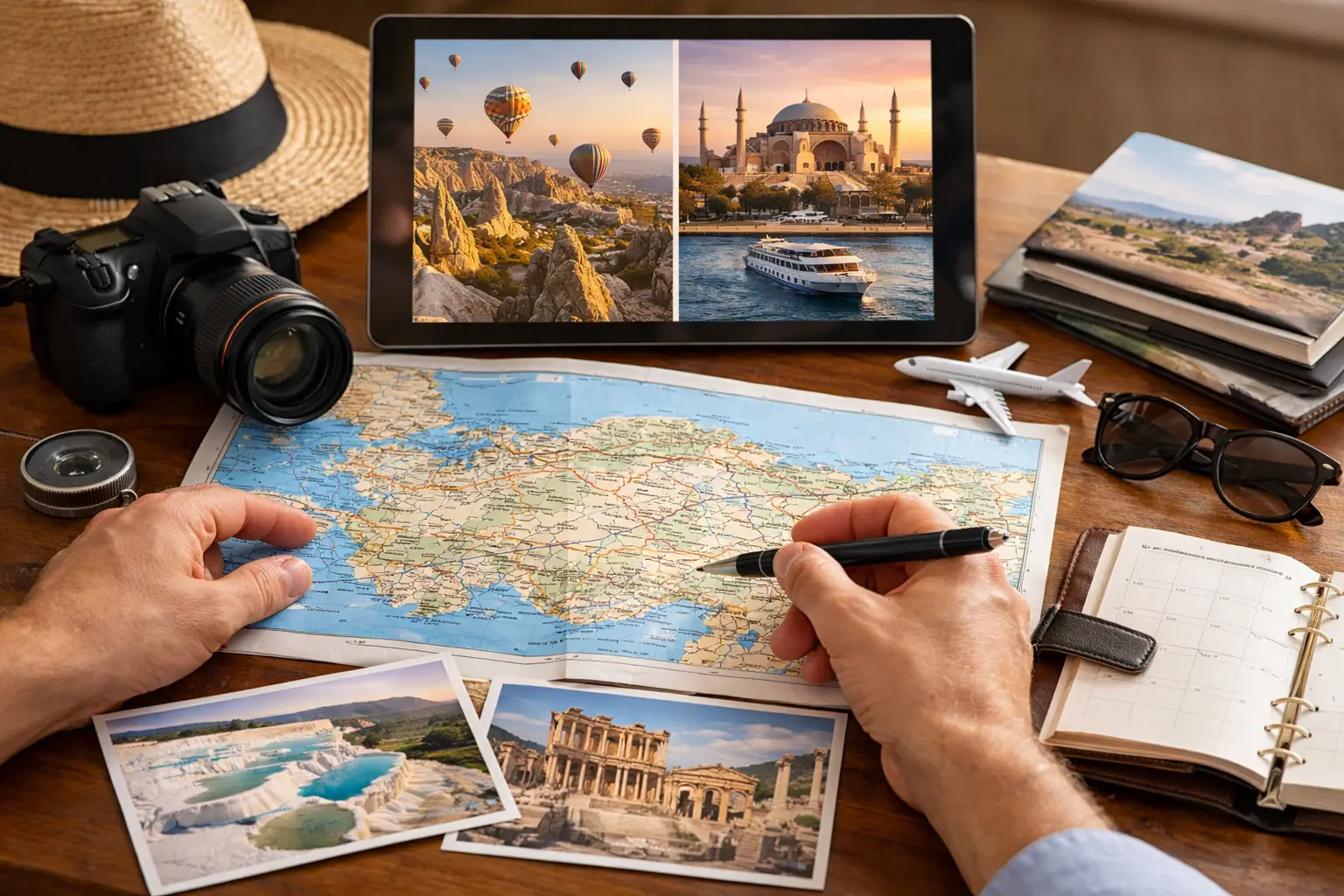
A good trip to Turkey (Türkiye) usually looks simple on paper – Istanbul, Cappadocia, maybe Ephesus, perhaps a few nights on the coast. The complication starts when you try to connect those places well. A private Turkey itinerary planner helps turn a long wish list into a route that actually works, with the right pacing, hotel choices, flights, transfers, and touring style for your travel goals.
For many travelers from the US and other long-haul markets, Turkey is not a one-stop destination. It is a country of layers: imperial history in Istanbul, underground cities and valleys in Cappadocia, Roman heritage in Ephesus, white terraces in Pamukkale, and yacht-lined coastal towns from Bodrum to Fethiye. The difference between a tiring trip and a very good one often comes down to planning logic rather than distance alone.
Why a private Turkey itinerary planner matters
Turkey rewards travelers who move smartly. Domestic flights can save time, but only when paired with the right airport transfers and check-in schedules. Overland routes can be scenic and comfortable, but not every connection is worth doing by road. A private Turkey itinerary planner looks at the full picture: where you land, how many days you have, which experiences matter most, and what level of comfort you expect.
This is especially useful if you want more than a standard loop. Some travelers want a history-focused route through Istanbul, Gallipoli, Troy, and Ephesus. Others prefer a classic first trip with Istanbul, Cappadocia, Pamukkale, and a short Mediterranean stay. Families may need spacious hotels and easy transfer days. Couples often want boutique cave suites, private guiding, and a few slower nights on the coast. The best itinerary is rarely the one with the most stops. It is the one with the right rhythm.
What a strong Turkey itinerary should include
A well-built itinerary is not just a list of destinations. It should balance culture, travel time, rest, and hotel quality.
Start with entry and exit points
Most private itineraries begin in Istanbul because it is Turkey’s main international gateway and a natural introduction to the country. That said, open-jaw planning can work well. Arriving in Istanbul and departing from Izmir, Bodrum, or Antalya may reduce backtracking if your route ends on the Aegean or Mediterranean coast.
This is one of the first places where professional planning helps. A route that looks efficient on a map can create awkward flight connections or unnecessary hotel changes. Sometimes one extra night in a city saves far more energy than trying to “see more.”
Match destinations to interests
Not every traveler needs every headline stop. If your priority is Ottoman and Byzantine heritage, Istanbul deserves more than two rushed nights. If landscapes and unique hotels matter most, Cappadocia may justify three nights instead of two. If ancient cities are high on your list, Ephesus should not be treated as just a quick pass-through from the airport.
Pamukkale works well as part of a broader western Turkey route, especially when paired with Ephesus. Antalya fits travelers who want a coastal base with access to archaeological sites and resort-style hotels. Bodrum, Marmaris, Fethiye, and Göcek are stronger choices for those who want sea time, elegant resorts, or a blue cruise element.
Build in realistic touring pace
This is where many self-made itineraries struggle. Turkey has a lot to offer, and first-time visitors often try to fit everything into seven or eight days. In practice, that usually means too many early departures and too little time on site.
A more comfortable pace often looks like this: three to four nights in Istanbul, two to three nights in Cappadocia, one to two nights around Kusadasi or Selçuk for Ephesus, one night if adding Pamukkale, then several nights on the coast if beach or yacht time is part of the plan. The exact mix depends on your season, budget level, and how much touring you want each day.
Best routes a private Turkey itinerary planner can create
The most popular route for first-time visitors is Istanbul, Cappadocia, and Ephesus, often in eight to ten days. This combination gives you a strong introduction to Turkey’s major cultural highlights without constant unpacking. It also works well with private tours and domestic flights.
A second strong option is Istanbul, Cappadocia, Pamukkale, and Ephesus. This adds more variety, especially for travelers interested in natural landscapes and archaeology. It requires tighter coordination, but when arranged properly, it feels balanced rather than rushed.
For travelers who want history plus coastline, a route such as Istanbul, Ephesus, Bodrum or Fethiye works particularly well in late spring through early fall. If you prefer a yacht experience, a gulet or blue cruise segment can turn a cultural itinerary into a broader vacation without losing structure.
If your interests lean toward World War I history and ancient sites, Gallipoli and Troy can be combined with Istanbul and western Turkey. This route usually works best for travelers willing to spend more time on the road, or those who want a private overland journey with guided stops along the way.
How many days do you really need?
Ten to twelve days is a comfortable starting point for a first private trip through Turkey (Türkiye). That gives enough time to enjoy Istanbul properly, include Cappadocia, add Ephesus or Pamukkale, and still keep travel days manageable.
With seven to eight days, it is better to focus on two or three regions and do them well. Istanbul and Cappadocia alone can make an excellent first trip. Adding Ephesus is possible, but only if flights and transfers are carefully arranged.
With two weeks or more, the itinerary becomes more flexible. You can add coastal destinations, a blue cruise, or extra nights in one place rather than simply collecting more cities.
Practical travel tips for planning Turkey
The best time for a multi-city private itinerary is generally April to June and September to October. These months are ideal for Istanbul touring, Cappadocia excursions, and western Turkey cultural routes. July and August are better for travelers who want coastal resorts, gulet cruising, and beach time, though inland touring can be warmer.
For a classic first route, plan 3 nights in Istanbul, 2 or 3 nights in Cappadocia, and 2 nights in the Ephesus area. If you want a more relaxed finish, add 3 or 4 nights in Bodrum, Antalya, or Fethiye.
One of the most efficient travel routes is Istanbul to Cappadocia by flight, Cappadocia to Izmir either by flight or through a structured touring connection, then onward to Ephesus and the coast. Another strong route is Istanbul to Gallipoli and Troy by private vehicle, continuing south toward Kusadasi before finishing on the Aegean.
Hotel selection matters as much as routing. In Istanbul, location affects your daily touring flow. In Cappadocia, cave hotels vary widely in style, view, and accessibility. On the coast, the right property depends on whether you want a lively town base, a quiet bay, or a full resort setting.
Private planning versus standard packages
There is nothing wrong with a fixed package if your dates, pace, and interests line up with the program. But a private plan gives you more control over the details that shape the trip: room category, guide style, driving times, departure hours, museum focus, and where to slow down.
That flexibility matters in Turkey because the country offers so many different combinations. A couple celebrating an anniversary may want premium hotels, a sunrise balloon-view room in Cappadocia, and a short gulet extension. A family may want interconnecting rooms, later morning starts, and fewer one-night stays. Retired travelers may prefer private airport assistance and a more measured pace across major sites.
This is also where experienced local support becomes valuable. An itinerary planner based in Turkey can coordinate flights, transfers, hotels, and guided services as one connected trip rather than a patchwork of bookings. Travel Store Turkey, for example, builds private and tailor-made routes that combine practical logistics with destination knowledge, which is often what turns a complex itinerary into an easy one.
When tailor-made travel is worth it
Tailor-made planning is worth it when your trip includes three or more regions, when comfort matters, or when you want a route shaped around specific interests rather than a generic checklist. It is also useful if you are visiting for a special occasion, traveling with family, or trying to combine inland heritage touring with a coastal stay.
The strongest tailor-made itineraries are clear about priorities. If you say yes to everything, you usually lose quality. If you choose what matters most – archaeology, food, scenery, boutique hotels, or coastal relaxation – the route becomes easier to design and much more enjoyable to travel.
A private Turkey itinerary planner is not just for adding luxury. It is for making smart choices about sequence, pacing, and regional balance, so each part of the trip supports the next one.
If you are planning Turkey for the first time, start with the experience you want rather than the map you have seen online. Once the route fits your pace and interests, the country opens up beautifully – and the journey feels far more relaxed from the moment you arrive.
Need Help Planning Your Turkey Itinerary?
Every traveler experiences Turkey differently. Some visitors want a classic route through Istanbul, Cappadocia, Ephesus, and Pamukkale, while others prefer luxury hotels, private guides, Blue Cruises, or a slower pace along the Mediterranean coast.
Travel Store Turkey specializes in Private Turkey Tours and tailor-made travel experiences throughout Turkey. Our local travel experts can design a personalized itinerary based on your travel dates, interests, budget, and preferred style of travel.
If you would like a customized Turkey itinerary with hotels, domestic flights, airport transfers, guides, and sightseeing included, please contact us. We will be happy to create a route that fits your schedule and travel goals.
0 Comment