


Imagine standing in a sprawling open square, surrounded by the magnificent Blue Mosque and Hagia Sophia. The air is filled with the scent of chestnuts roasting on street carts, and the distant call to prayer echoes across the historic peninsula. This is Sultanahmet Square, one of Istanbul’s most visited destinations, attracting over 2 million visitors annually . But beneath your feet lies something extraordinary—the ancient track of the Hippodrome of Constantinople, where chariots once thundered, emperors ruled, and crowds of up to 100,000 spectators roared with excitement .
For nearly 1,000 years, the Hippodrome was the beating heart of the Byzantine Empire—a place of sport, politics, rebellion, and imperial ceremony . Today, while the grandstands have vanished, the square still holds ancient treasures that transport you back in time. In this complete 2026 guide, we will explore the history, surviving monuments, and practical tips for visiting one of Istanbul’s most significant historical sites.
The History: From Byzantium to Ottoman Istanbul
The story of the Hippodrome begins long before Constantinople became the glittering capital of an empire. Its foundations were laid in AD 203 by the Roman Emperor Septimius Severus, who rebuilt the city of Byzantium and endowed it with a hippodrome for chariot racing and public entertainment .
Constantine’s Grand Vision
When Emperor Constantine the Great refounded the city as his new capital in AD 324, he transformed the modest hippodrome into a monumental arena befitting the “New Rome” . The structure measured an impressive 450 meters (1,476 feet) in length and 130 meters (427 feet) in width—making it one of the largest public spaces in the ancient world .
The U-shaped track featured tiered seating that could accommodate tens of thousands of spectators. At its eastern end sat the Kathisma, the emperor’s private box, which connected directly to the Great Palace through a passage accessible only to the imperial family . This physical connection symbolized the intimate relationship between the ruler and the people—a relationship often tested within these very walls.
The Nika Revolt: When the Hippodrome Ran Red
The most dramatic moment in Hippodrome history occurred in AD 532 during the infamous Nika Revolt. The city’s rival racing factions—the Blues and the Greens—united against Emperor Justinian I, adopting the chant “Nika!” (Victory!) as their battle cry .
For five days, Constantinople burned. Rioters destroyed churches, including the original Hagia Sophia, and proclaimed a new emperor. Justinian, ready to flee, was famously urged to stay by his wife Empress Theodora, who declared that “purple makes a fine burial shroud” .
The emperor’s generals, Belisarius and Mundus, trapped the rebels in the Hippodrome and slaughtered an estimated 30,000 people in a single day . This brutal suppression secured Justinian’s throne and led to the construction of the Hagia Sophia we see today.
Ottoman Transformation
After the Ottoman conquest of 1453, the Hippodrome’s purpose changed dramatically. The Ottomans had no tradition of chariot racing, so the arena gradually fell into disuse . However, the site was never built over, remaining an open space that became known as At Meydanı (“Horse Square”) . It continued to host Ottoman ceremonies, festivals, and even occasional rebel executions, preserving its role as a center of public life for another 400 years .
The Three Ancient Monuments: Walking the Spina
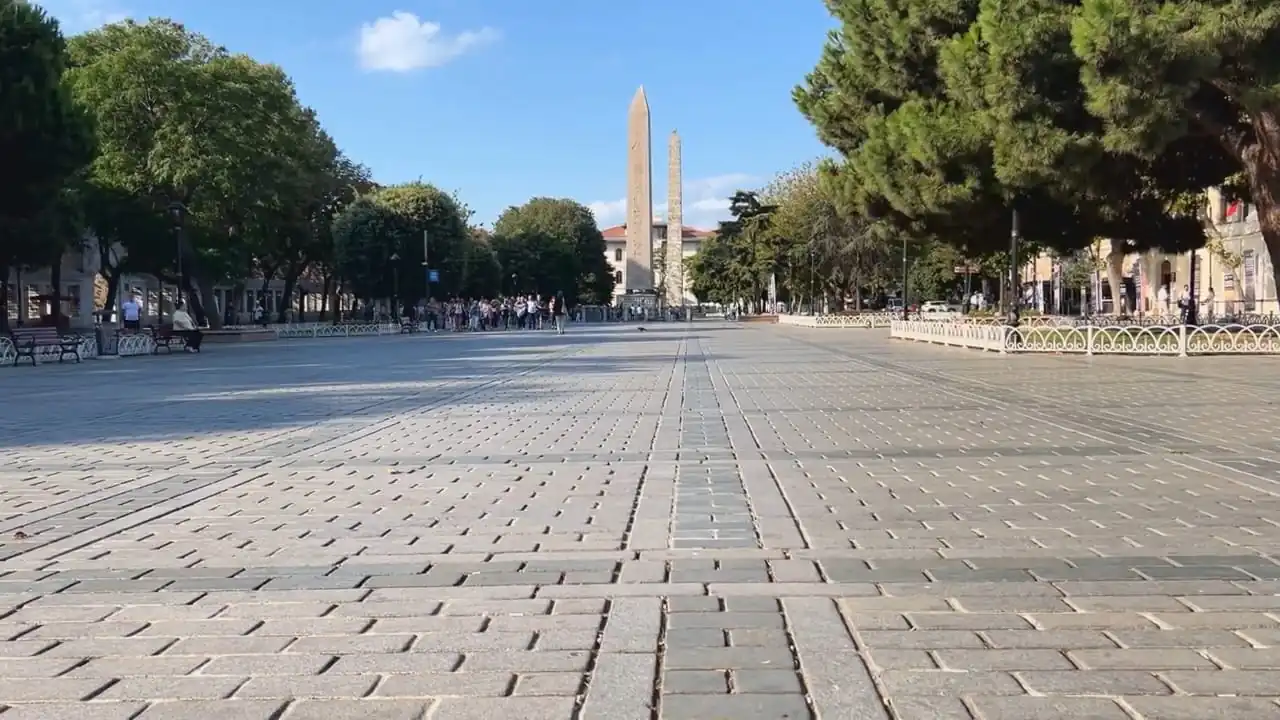
In ancient chariot racing, the spina was the central barrier around which chariots thundered for seven laps . Emperors adorned this spine with magnificent monuments brought from across the empire. Three of these still stand today, now resting in landscaped pits in Sultanahmet Square.
1. The Obelisk of Thutmose III (Theodosius Obelisk)
The oldest and most impressive monument in the square dates back nearly 3,500 years. Carved from pink granite, this obelisk was originally erected at the Temple of Karnak in Luxor, Egypt, during the reign of Pharaoh Thutmose III (c. 1490 BC) .
Emperor Theodosius the Great brought the obelisk to Constantinople in AD 390. The massive monument was cut into three pieces for transportation; only the top section survives today, standing on a marble pedestal decorated with relief carvings depicting Theodosius and his family watching chariot races .
-
Height: Approximately 20 meters (originally much taller before cutting)
-
Material: Red granite from Aswan, Egypt
-
Base Reliefs: Show Theodosius, his court, and scenes of obelisk erection
2. The Serpent Column (Delphi Tripod)
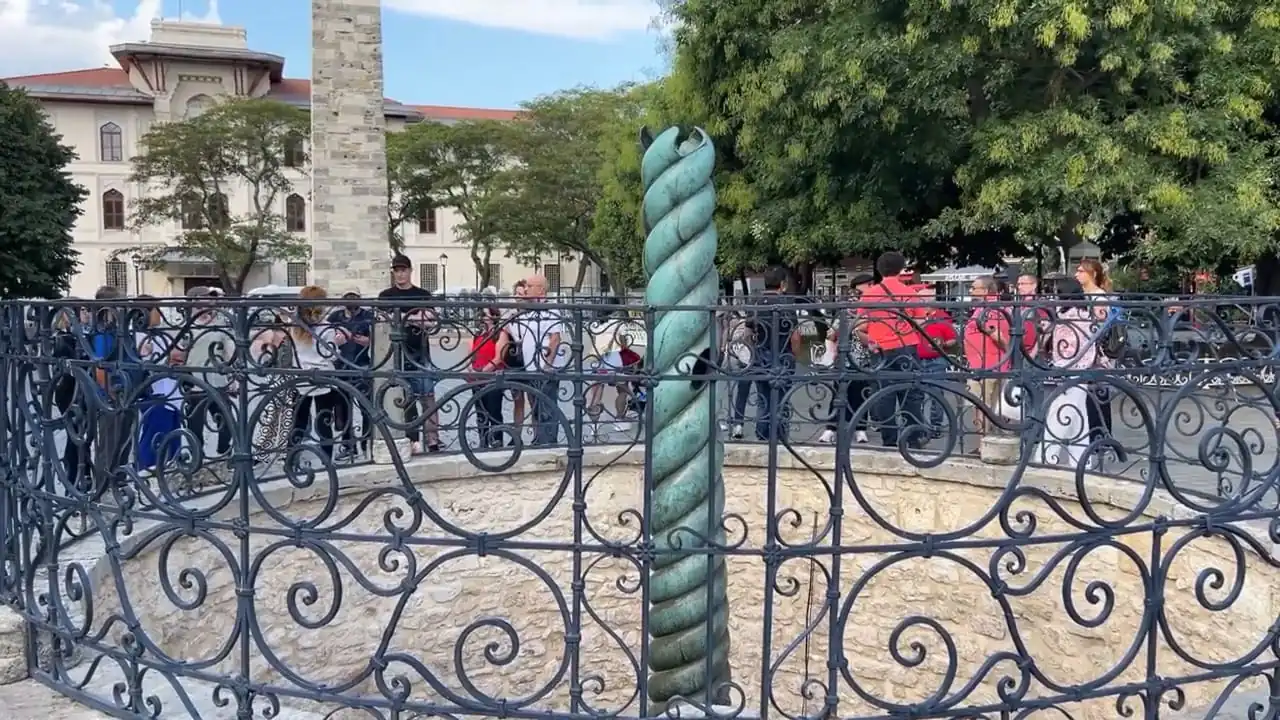
Perhaps the most historically significant artifact in Istanbul, the Serpent Column predates Constantinople by nearly 1,000 years. It was originally cast to celebrate the victory of the Greek city-states over the Persians at the Battle of Plataea in 479 BC .
The column stood in the Sanctuary of Apollo at Delphi, formed by the entwined bodies of three serpents, whose heads once supported a golden tripod . Constantine the Great ordered it moved to his new capital to link Constantinople with the glorious Greek past .
-
Original Height: Approximately 8 meters (the top third is missing)
-
Material: Bronze
-
Current State: The serpent heads were lost in 1700; one surviving jaw is displayed at the Istanbul Archaeology Museum
3. The Walled Obelisk (Masonry Obelisk)
At the southern end of the square stands the third monument, built by Emperor Constantine VII Porphyrogenitus in the 10th century AD . Unlike the Egyptian obelisk, this one was constructed from cut stone blocks.
Originally, it was covered with gilded bronze plaques depicting the empire’s victories, gleaming brilliantly in the Mediterranean sun. However, during the Fourth Crusade in 1204, Latin troops stripped the valuable bronze, leaving only the bare stone core visible today .
-
Height: Approximately 32 meters
-
Construction: Rough-cut stone blocks
-
Inscription: A Greek inscription records its restoration in the 10th century
The German Fountain: An Ottoman-Era Addition
Near the northern entrance of the Hippodrome, adjacent to the Blue Mosque, stands an elegant octagonal domed fountain that looks distinctly European. This is the German Fountain (Alman Çeşmesi) , constructed by the German government to mark Emperor Wilhelm II’s visit to Istanbul in 1898 .
Built in neo-Byzantine style with gleaming golden mosaics, the fountain was shipped in pieces from Germany and assembled on its current site in 1900 . It symbolizes the historical friendship between the German and Ottoman Empires and remains a popular meeting point for visitors today.
The Sphendone: The Only Visible Ruins
While most of the Hippodrome lies buried approximately 2 meters below the current ground level, one significant structure remains visible . At the square’s southern end, you can see the surviving lower walls of the Sphendone—the curved grandstand that formed the U-shaped end of the racing track .
These massive vaults, constructed where the land slopes toward the sea, give visitors their only physical sense of the Hippodrome’s original scale. In Byzantine times, these vaults were later sealed and used as a cistern to store water .
Practical Information for Your 2026 Visit
Essential Details
-
Location: Sultanahmet Meydanı, Binbirdirek, Sultan Ahmet Parkı No:2, 34122 Fatih/İstanbul
-
Admission: FREE (open-air public square)
-
Hours: Open 24 hours a day, 7 days a week
-
Recommended Visit Duration: 1 to 1.2 hours
-
Annual Visitors: Over 2 million
-
UNESCO Status: Part of the “Historic Areas of Istanbul,” designated in 1985
How to Get There
The Hippodrome sits in the heart of Sultanahmet, easily accessible:
-
By Tram: Take the T1 tram line to the Sultanahmet stop. The square is a 2-minute walk.
-
Walking: From Hagia Sophia or the Blue Mosque, you are already there—the square connects both landmarks.
Nearby Attractions
Combine your Hippodrome visit with these world-famous sites, all within walking distance:
-
Hagia Sophia: The architectural masterpiece of the Byzantine Empire
-
Blue Mosque (Sultan Ahmed Mosque): Ottoman imperial mosque with iconic blue tiles
-
Basilica Cistern: Ancient underground water reservoir
-
Topkapı Palace: Home of Ottoman sultans for nearly 400 years
-
Istanbul Archaeology Museums: Houses artifacts from the Hippodrome, including serpent heads and statue bases
Tips for Your Visit
-
Best Time to Visit: Early morning (before 9:00 AM) or late afternoon for pleasant weather and fewer crowds
-
Photography: The monuments are beautifully lit at night; sunset offers stunning views with the Blue Mosque in the background
-
Guided Tours: While the square is free, consider a guided historical tour to fully appreciate the hidden history beneath your feet
-
Combine Sights: The Hippodrome connects directly to both Hagia Sophia and the Blue Mosque—perfect for a full day of sightseeing
-
Look Down: The track level is approximately 2 meters below the current surface—imagine the chariots racing beneath you
Fun Facts: Did You Know?
-
The four gilded bronze horses that once stood atop the Hippodrome’s starting gates were looted during the Fourth Crusade in 1204 and now adorn St. Mark’s Basilica in Venice
-
The Hippodrome appeared on the reverse of Turkish 500 lira banknotes issued between 1953 and 1976
-
Excavations in 1993 revealed original seating rows and columns, now displayed in Istanbul’s museums
-
The word “hippodrome” comes from Greek hippos (horse) and dromos (path)—literally “horse path”
The Hippodrome of Constantinople offers something unique among Istanbul’s historic sites—it requires imagination. Unlike the enclosed grandeur of Hagia Sophia or the soaring minarets of the Blue Mosque, the Hippodrome asks visitors to look beneath the surface, to visualize the thundering chariots, the roaring crowds, and the emperors who once held the fate of empires in their hands from the Kathisma box.
0 Comment