

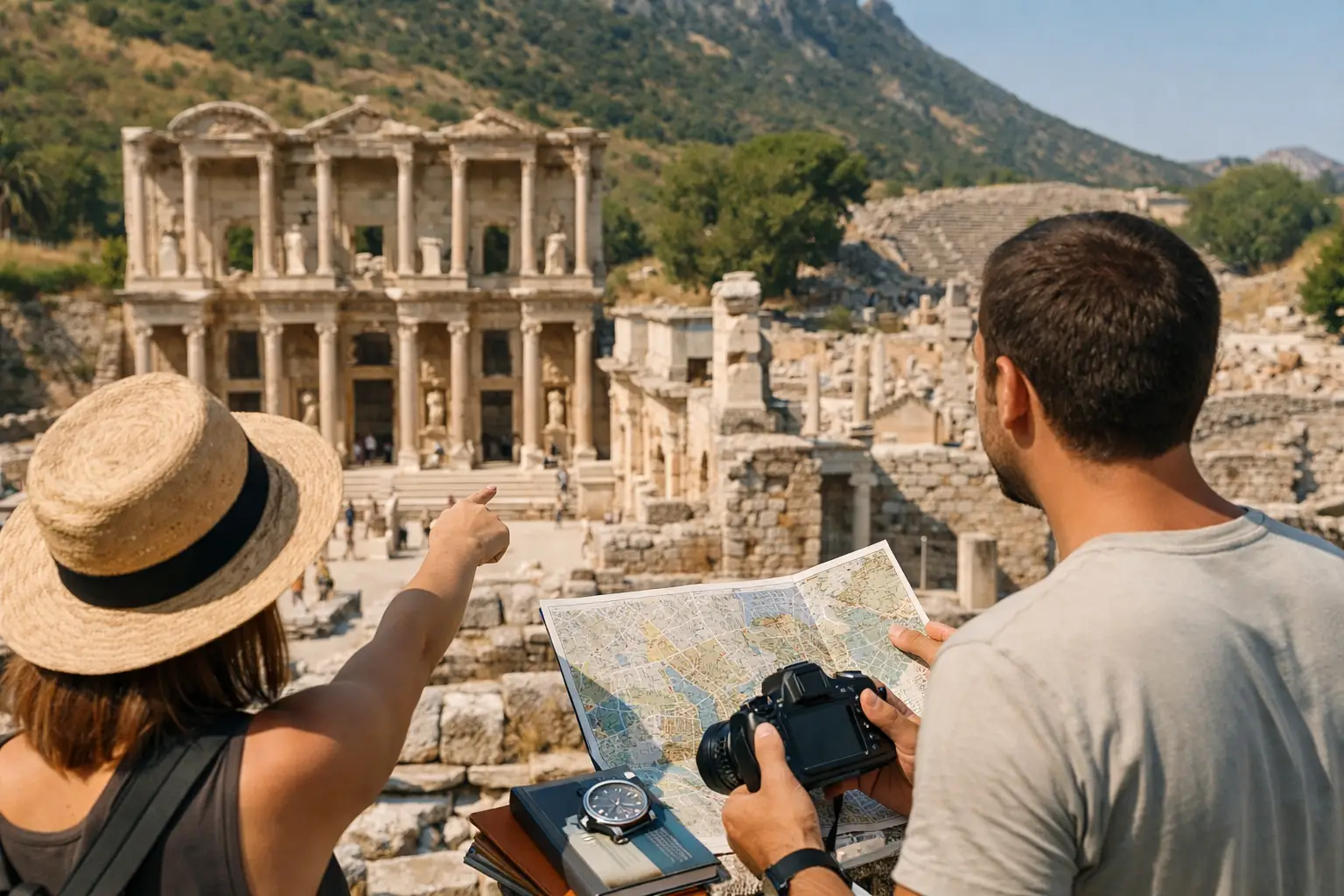
How to Visit Ephesus Efficiently: Timing, Route and Practical Tips
Ephesus is one of those places where a well-timed plan changes the entire experience. The marble avenues, library facade, terrace homes, and grand theater deserve unrushed attention, yet the site is large enough that an unplanned visit can become hot, crowded, and tiring. Knowing how to visit Ephesus efficiently means arranging the right arrival point, building in enough time for its essential monuments, and pairing the ancient city with a comfortable base nearby.
For travelers fitting Ephesus into a larger Turkey itinerary, the most effective approach is usually a guided Ephesus day tour rather than treating it as a quick stop between hotels. The logistics are straightforward with local planning, and the reward is a day that feels informed rather than hurried.
Start at the Upper Gate and Walk Downhill
Ephesus has two main entrances: the upper gate near the State Agora and the lower gate near the harbor area. For most visitors, entering through the upper gate is the more efficient choice. The route then follows a gentle downhill progression through the city, ending near the Great Theater and lower exit.
This order makes the major sights easier to understand. You begin in the administrative and civic center, continue along Curetes Street past fountains, temples, and public buildings, then arrive at the Library of Celsus before reaching the theater. It is also kinder on the legs, especially from late spring through early fall when the Aegean sun can be strong.
A guided Ephesus tour can arrange drop-off at the upper entrance and collection at the lower exit, avoiding the need to retrace your steps. This small logistical detail saves energy and keeps the day moving naturally. Visitors arriving independently should still confirm their transport plan in advance, since the two gates are not beside one another.
Give Ephesus Enough Time, but Not All Day
For the main archaeological site, allow around two to three hours. That is enough time to see the essential monuments at a measured pace, take photographs, hear the historical context, and pause in shaded areas where available. Visitors with a strong interest in archaeology, ancient urban life, or Roman architecture should allow closer to three and a half hours.
The most efficient visit is not necessarily the shortest. Rushing through the Library of Celsus or the Great Theater to squeeze in extra stops often leaves travelers with a collection of photos but little sense of how the city functioned. A licensed local guide helps put the scale into perspective: Ephesus was a major port city, commercial center, and cultural crossroads, not simply a series of isolated ruins.
The Terrace Houses deserve separate consideration. This additional section preserves the residences of wealthy Ephesians, with mosaics, frescoes, heating systems, and carefully designed rooms. Plan 30 to 45 extra minutes if you include them. They are worthwhile for travelers who want to see how the city’s elite lived, but families with young children or guests on a tighter schedule may prefer to focus on the outdoor route.
Arrive Early for a Calmer Visit
An early start is the simplest way to improve an Ephesus day. Aim to enter close to opening time, particularly between May and October and during busy holiday periods. Morning light is also more forgiving for photographs around the library and marble streets, while temperatures are generally more comfortable.
If an early arrival is not possible, a later-afternoon visit can work well, depending on seasonal opening hours and your onward plans. The trade-off is that you need to watch the time carefully and may have less flexibility for the Terrace Houses or nearby museums. Midday is best reserved for lunch, a hotel break, or travel between nearby towns.
Your guide can adjust the sequence to match your hotel location and cruise schedule. For example, travelers staying in Kuşadası may begin directly at Ephesus, while those arriving from Izmir may combine the site with a relaxed lunch in Selçuk before continuing to their hotel.
Focus on the Monuments That Tell the Story
Ephesus can feel overwhelming if you attempt to absorb every stone inscription and reconstructed column. A good route focuses first on the places that reveal the city’s structure and atmosphere: the State Agora, Odeon, Curetes Street, Hadrian’s Temple, public latrines, Library of Celsus, Commercial Agora, and Great Theater.
The Library of Celsus is the visual highlight for many visitors, but it becomes more meaningful when approached through the city’s main streets. Its impressive facade was designed as a statement of learning, prosperity, and civic pride. The Great Theater, which could hold tens of thousands of spectators, provides the clearest sense of Ephesus at monumental scale.
Do not overlook the smaller details between these landmarks. Carved paving, water channels, shopfronts, fountains, and column fragments reveal an urban environment that was carefully organized for trade, public life, and ceremony. A guide can help you distinguish original remains from restoration work and point out features that are easy to pass without noticing.
Build a Practical Ephesus Day Around Selçuk or Kuşadası
Ephesus lies near Selçuk and within easy reach of Kuşadası, both useful bases with different advantages. Selçuk is closer to the archaeological site and suits travelers who prefer a quieter, history-focused overnight stop. Kuşadası offers a broader choice of seaside hotels and is convenient for those continuing along the Aegean coast or arriving by cruise ship.
A comfortable full-day plan often begins with hotel pickup, a morning visit to Ephesus, and lunch after the archaeological site. Depending on your interests and available time, the afternoon can include the Ephesus Archaeological Museum in Selçuk or a visit to the traditional village of Şirince.
The museum is particularly useful if you want to see sculptures and objects found at the site in a more protected setting. Şirince is better suited to guests who would enjoy a slower village stop after a monument-rich morning.
Trying to combine Ephesus, multiple museums, a long shopping stop, and a distant airport transfer in one day is possible, but not always enjoyable. The better choice depends on your travel pace. A tailor-made itinerary can prioritize archaeology, local food, family-friendly timing, or a direct connection to your next destination.
Combine Ephesus and Pamukkale Efficiently
Ephesus pairs naturally with Pamukkale because the two destinations provide very different experiences within the same western Turkey route. Ephesus offers marble streets, Roman architecture, and detailed urban history, while Pamukkale combines white mineral terraces with the ancient city of Hierapolis.
Travelers with limited time can arrange a 2-Day Ephesus and Pamukkale Tour from Istanbul. This avoids managing separate flights, airport transfers, hotels, guides, and overland transportation independently.
For travelers with more time, the 5-Day Istanbul, Ephesus and Pamukkale Tour adds Istanbul’s major historical landmarks while keeping the western Turkey section comfortably organized.
Practical Travel Tips for Ephesus
The best time to visit is generally April through June or September through October, when temperatures are more comfortable for walking and daylight is generous. July and August are excellent for broader Aegean travel, but an early site entry becomes especially valuable. Winter brings fewer visitors and a quieter atmosphere, although occasional rain and shorter days should be expected.
One night in Selçuk or Kuşadası is ideal if Ephesus is a major priority. It allows for a relaxed morning visit and avoids treating the site as a rushed excursion. Travelers with limited time can visit from Izmir in a day, while guests following a multi-city route may continue afterward toward Pamukkale, Bodrum, or the coast.
For clothing, choose comfortable walking shoes with a secure sole, light layers, sunglasses, and a hat. Much of the archaeological site is exposed, and marble pathways can be uneven. Carry water, although your driver can also keep additional supplies in the vehicle during a private tour.
Recommended Turkey Routes Including Ephesus
Istanbul to Izmir by domestic flight followed by a private transfer is the most efficient route for many international travelers. Ephesus can then be combined with Pamukkale over two or three days or added to a longer itinerary covering Istanbul and Cappadocia.
For a first journey across Turkey, the 8-Day Private Turkey Tour combines Istanbul, Cappadocia, Ephesus, and other major destinations with private transportation and flexible touring.
Travelers who prefer a longer route can consider the 9-Day Turkey Tour, which connects Istanbul, Cappadocia, Ephesus, Pamukkale, and Antalya.
The 10-Day Multi-City Turkey Tour allows more time for domestic flights, hotels, archaeological visits, and guided touring without compressing every destination into a short schedule.
Travelers planning an extended journey can also review the 14-Day Best of Turkey Tour, which includes Ephesus as part of a broader itinerary across Turkey’s major cultural and scenic regions.
Make the Travel Day Work Around You
The difference between a good Ephesus visit and a memorable one is usually not a longer checklist. It is having the right transport, a sensible entrance strategy, enough time at the monuments that matter to you, and a guide who can adapt the pace as the day unfolds.
Travel Store Turkey can arrange private Ephesus tours, small-group options, boutique hotel stays, domestic flights, and transfers as part of a tailored Turkey itinerary. Whether Ephesus is your main destination or one chapter in a journey from Istanbul and Cappadocia to Pamukkale and the Aegean coast, a carefully planned day lets the ancient city remain the focus.
Explore all available Ephesus tours, compare routes on the Turkey Tours by Duration page, or book the Ephesus Day Tour from Istanbul.
0 Comment