

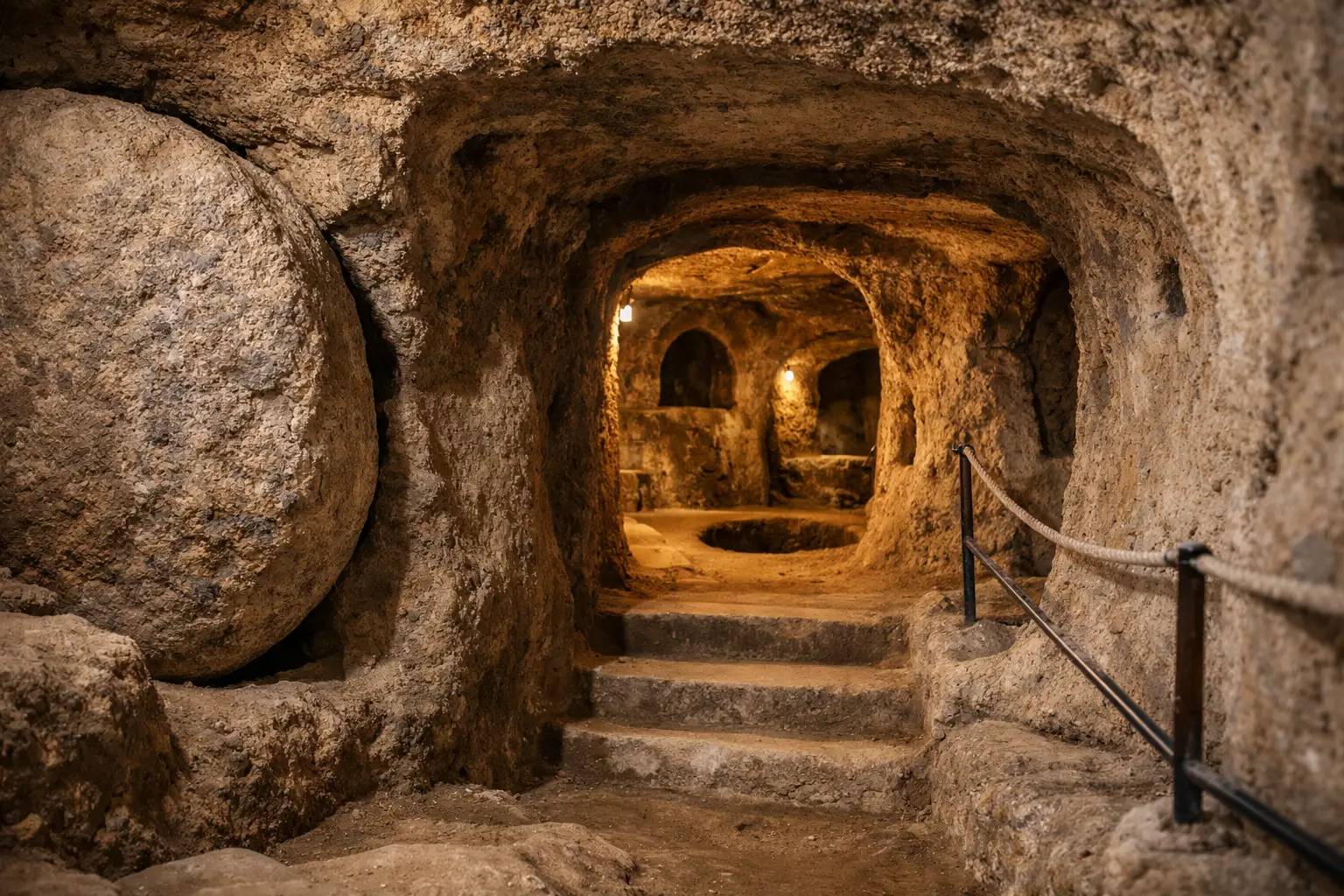
The entrance to Cappadocia Kaymaklı Underground City gives little warning of what lies below: a carefully engineered network of low corridors, ventilation shafts, storage rooms, kitchens, and communal spaces carved into soft volcanic rock. For travelers who have admired Cappadocia’s open-air valleys and fairy chimneys, Kaymaklı offers the region’s most striking contrast. This is not simply a historic stop between photo viewpoints. It is a place that makes Cappadocia’s long human story feel immediate.
Located near Nevşehir, Kaymaklı is one of the best-known underground settlements in central
Cappadocia.
It works particularly well within a
private Cappadocia tour
because the visit involves stairs, narrow passages, and timing that benefit from a calm, well-organized pace. A licensed local guide can explain what each space was designed to do, while your itinerary can balance the underground visit with the expansive landscapes above ground.
Why Kaymaklı Underground City Matters
Cappadocia’s landscape was formed by ancient volcanic activity, leaving layers of tuff rock that could be carved with basic tools while remaining stable enough for rooms and passageways. Local communities used this advantage over centuries, creating sheltered spaces that could be closed off when needed and supplied for extended stays.
Kaymaklı was not a single cave or a short hiding place. It was a functioning underground settlement with areas for food storage, wine production, animals, cooking, and daily life. Large circular stone doors could be rolled across certain corridors from the inside. Ventilation shafts brought air down through the levels, while wells and water systems supported the community.
The precise development of Cappadocia’s underground cities spans different periods, and historians continue to discuss how individual sections were built and expanded. What is clear to visitors is the scale of planning. The rooms connect in a way that reflects practical priorities: protecting supplies, managing air, moving people through confined spaces, and creating separate working areas.
Kaymaklı is often compared with nearby Derinkuyu, another major underground city. Derinkuyu is generally known for greater depth, while Kaymaklı is widely appreciated for its more horizontal layout and its strong sense of interconnected living spaces. Neither is automatically “better.” Travelers interested in the largest vertical descent may prefer Derinkuyu; those seeking a well-paced introduction to subterranean Cappadocia often find Kaymaklı especially rewarding.
What You Will See Inside Cappadocia Kaymaklı Underground City
Only a portion of the full complex is open to visitors, but the accessible route is substantial enough to show how the city worked. Expect a one-way path through a succession of chambers and connecting tunnels rather than a broad, open museum floor.
Storage Rooms, Kitchens, and Wineries
One of Kaymaklı’s most revealing features is its practical infrastructure. Storage niches and larger rooms point to the importance of preserving food below ground. You may see areas identified as kitchens, along with blackened surfaces associated with cooking activity, and spaces used for pressing or storing wine.
These details matter because they shift the experience beyond architecture. They show that the city supported everyday routines, not only emergency shelter. A guide can help distinguish between interpretations based on visible features and details that remain uncertain.
Ventilation Shafts and Narrow Passages
The air shafts are among the most impressive elements of the site. They served as vital channels for fresh air and, in some cases, access to water. Looking into them offers a clear sense of how far the complex extends beyond the rooms visible along the visitor route.
Passageways can be low and narrow. Some require visitors to bend briefly, and the route includes uneven stone floors and stairs. This physical character is part of Kaymaklı’s appeal, but it also means that travelers with significant mobility limitations or strong discomfort in enclosed spaces should discuss alternatives when planning their
Cappadocia itinerary.
Stone Doors and Defensive Design
The round stone doors are the feature most visitors remember. These heavy discs were designed to roll into position across narrow entrances, creating a barrier from within the settlement. Their placement also reveals why the corridors were built at such a controlled scale.
Rather than viewing the site as a sequence of isolated rooms, notice how each turn, doorway, and shaft connects to the next. Kaymaklı’s significance lies in this system of movement and survival, shaped directly into the rock.
How to Include Kaymaklı in a Cappadocia Itinerary
For most visitors, Kaymaklı fits best on a full-day Cappadocia sightseeing route. A typical day might begin with an early morning
hot air balloon flight in Cappadocia,
followed by time to rest and breakfast at a cave hotel before continuing with the underground city, a valley walk, scenic viewpoints, and a pottery or craft stop in Avanos.
It is possible to visit after a balloon flight, but the right order depends on your energy level and the season. In summer, an underground city can provide a welcome break from the midday sun. In winter, its relatively steady interior temperature makes it a useful addition to an outdoor-focused day. Private touring offers the most flexibility, allowing time for a relaxed lunch and adjustments if a balloon flight runs later than expected.
A well-planned two-night Cappadocia stay allows time for Kaymaklı without rushing the region’s other highlights. Three nights is better for travelers who want a balloon flight, hiking in one or two valleys, a hands-on local experience, and slower mornings at a boutique cave hotel.
Cappadocia also pairs naturally with
Istanbul
in a multi-city Turkey itinerary, using domestic flights and pre-arranged airport transfers to keep the journey efficient. Travelers with limited time can also consider a
2 Days Cappadocia Tour from Istanbul.
Practical Tips for Visiting Kaymaklı
Wear comfortable closed-toe shoes with a good grip. The underground route is stone underfoot, with steps and places where you will need to lower your head. Light layers are sensible, since the interior feels cooler than a sunny Cappadocia afternoon but is not excessively cold.
Bring only what you need. A small bag is easier to manage through narrow sections, and there is little value in carrying bulky items. Photography may be allowed in many areas, but flash is best avoided so other visitors can move comfortably through the darker passages.
Allow roughly 45 minutes to an hour for the visit itself, depending on crowd levels and how much explanation you want. The best time to visit is generally spring or fall, when Cappadocia’s weather is pleasant for combining indoor sites with valleys and viewpoints. Summer travelers should schedule thoughtfully around heat, while winter visitors should allow extra flexibility for weather-related changes to outdoor activities.
For families, Kaymaklı can be memorable for older children who are comfortable with enclosed spaces and enjoy history that feels hands-on. Younger children may find the low tunnels tiring or intimidating. A private guide and vehicle make it easier to adapt the day around your family’s pace.
A More Comfortable Way to See Cappadocia
Kaymaklı is easy to appreciate when transportation, entry timing, and the wider day are handled with care. Instead of treating it as a quick stop, build it into an itinerary that gives the site context: the volcanic landscape that made it possible, the villages above it, and the cave hotels that continue Cappadocia’s relationship with carved stone.
Travel Store Turkey can arrange customized
private and small-group Cappadocia tours
with licensed local guides, carefully selected cave hotel options, domestic flight planning, and airport transfers.
Whether Kaymaklı is part of a short Cappadocia escape or a longer Turkey journey through
Istanbul,
Ephesus,
and Pamukkale, a tailored route lets you experience the underground city without sacrificing the region’s best views above ground.
For travelers who want to combine Turkey’s most important destinations in one journey, our
8 Days Turkey Tour Package
includes Istanbul, Cappadocia, Ephesus, and Pamukkale.
Leave Kaymaklı with time afterward for daylight. Stepping back into the wide Cappadocian landscape after an hour beneath it is one of the most memorable transitions the region can offer.
Planning a Cappadocia trip?
Contact Travel Store Turkey
to create a customized private or small-group Turkey itinerary.
0 Comment