
Is Ephesus Worth Visiting? A Practical Guide for Turkey Travelers
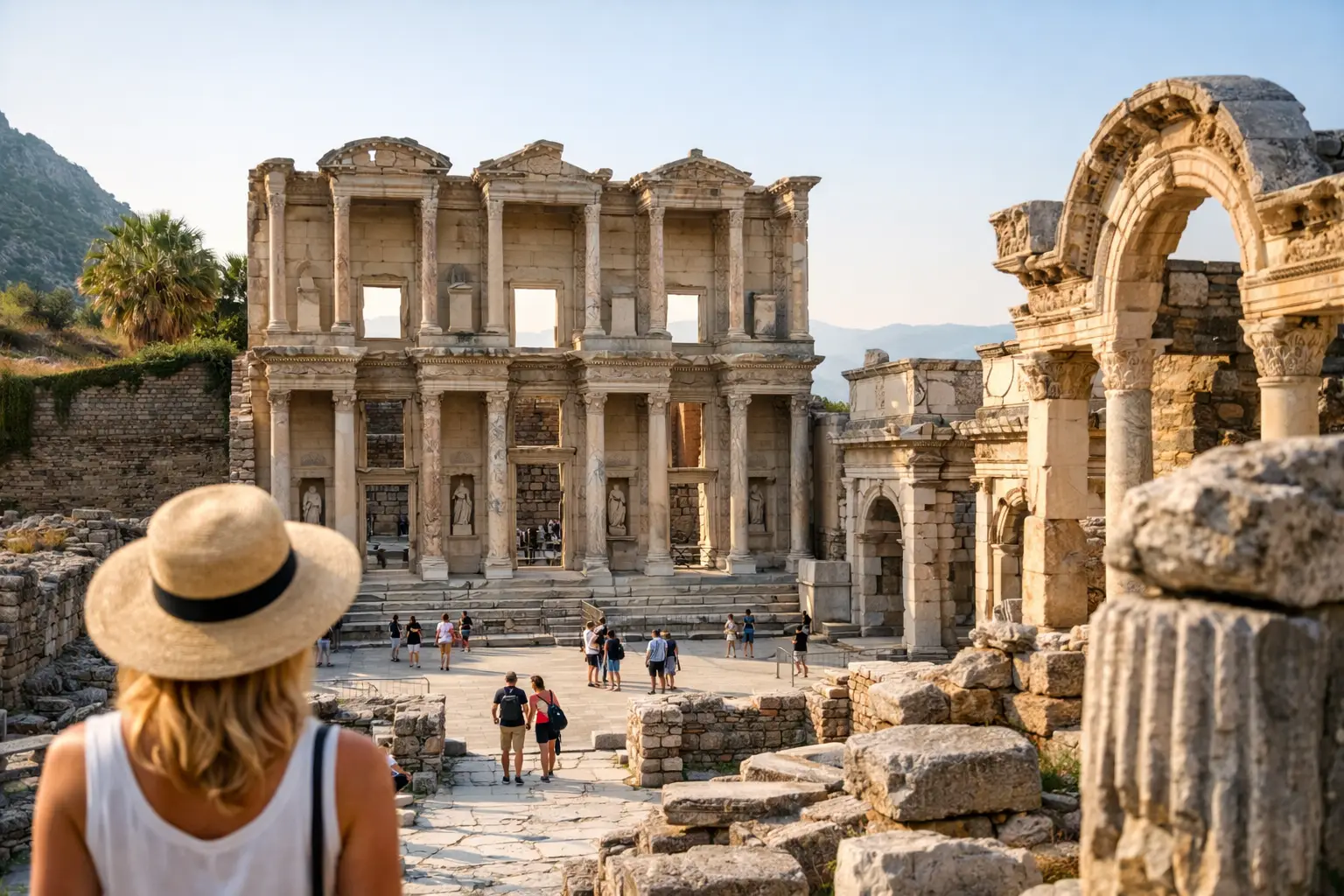
A marble avenue polished by two millennia of footsteps leads toward the Library of Celsus, one of the most recognizable façades in the ancient world. For travelers building a Turkey itinerary, is Ephesus worth visiting? For most, the answer is yes – especially if you want a major historical site that feels large enough to explore rather than simply photograph.
Ephesus is not a small collection of ruins with a quick stop attached. It was once a thriving Mediterranean city, and its streets, public buildings, homes, fountains, and theater reveal how ambitious Roman urban life could be. A well-planned visit gives the site context and allows enough time to appreciate its scale without rushing through it in the midday heat.
Why Ephesus Is Worth Visiting
What makes Ephesus distinctive is how much of the city plan is still understandable. Visitors can walk along broad stone streets, pass the remains of commercial areas and civic buildings, and see how the city moved downhill toward its former harbor. Rather than looking at isolated columns, you are moving through the framework of a real ancient city.
The Library of Celsus is the visual highlight. Its restored façade is impressive in photographs, but it has more impact in person because of its setting at the end of Curetes Street. The Great Theater is equally memorable. Built into the hillside, it offers sweeping views over the archaeological site and conveys the scale of public life in Ephesus.
For travelers who enjoy architecture and daily-life history, the Terrace Houses are often the deciding factor. These excavated residences preserve mosaics, frescoes, heating systems, and interior layouts that show how wealthy families lived. Entry is separate from the main archaeological site, but it is usually worth including if you have an interest in Roman design, archaeology, or more detailed interpretation.
Ephesus also works exceptionally well as part of a broader Turkey journey. It adds a strong historical contrast to Istanbul, Cappadocia, and Pamukkale. Travelers who have already seen ancient ruins elsewhere may still find Ephesus compelling because it is both extensive and remarkably legible.
When Ephesus May Not Be the Right Fit
Ephesus is worth visiting, but the experience depends on your interests, pace, and itinerary. It is an outdoor archaeological site with uneven stone paths, limited shade in several areas, and a fair amount of walking. Travelers with very limited mobility should arrange a private visit with a vehicle and guide who can adapt the route around their comfort level.
It may also feel less essential if your trip is very short and focused entirely on Istanbul or the coast. Reaching the Ephesus area from Istanbul is most efficient by domestic flight, usually via Izmir, and then a private transfer to the Selçuk or Kuşadası area.
If you only have three or four days in Turkey, concentrating on one or two regions can make the trip feel more relaxed. Travelers planning a longer journey can review our guide on how many days in Turkey is enough before deciding how to fit Ephesus into the route.
For an itinerary of seven days or longer, Ephesus is usually one of the most rewarding additions. It fits naturally into routes that combine Istanbul, Ephesus, Pamukkale, and Cappadocia, with domestic flights and ground transportation arranged to minimize unnecessary backtracking.
For example, an 8 Days Turkey Tour can combine several of Turkey’s major cultural destinations without turning every day into a long transfer.
The Highlights to Prioritize in Ephesus
A knowledgeable licensed guide can turn a beautiful set of ruins into a coherent story. Without explanation, it is easy to admire the Library of Celsus and theater but miss the details that make the city more meaningful: water channels under the streets, inscriptions, bath complexes, markets, and the structure of private homes.
The main visit generally follows the upper and lower portions of the city. Key stops include the State Agora, Odeon, Curetes Street, Hadrian’s Temple, the Terrace Houses, the Library of Celsus, Marble Road, and the Great Theater. The Harbor Street area completes the sense of Ephesus as a city connected to trade and the wider Mediterranean world.
Allow time to pause rather than treating every landmark as a checkpoint. The view down Curetes Street, the decorative details around the library, and the theater’s setting are best appreciated when the schedule leaves room for them.
Private Ephesus tours are especially useful for travelers who want to spend longer at the Terrace Houses, focus on architecture, or adjust the walking pace for family members.
The Terrace Houses: Worth the Extra Time?
For many visitors, yes. The Terrace Houses offer a closer view of domestic life than the open-air public monuments can provide. Covered walkways protect the active excavation areas, and the elevated paths make it possible to look down on rooms with detailed floor mosaics and wall decoration.
They are not essential for every traveler. If you prefer a shorter visit centered on major landmarks, the main city alone is satisfying. But if Ephesus is one of the central reasons for your Turkey trip, adding the Terrace Houses makes the experience more complete.
How Long Should You Spend in Ephesus?
Plan for at least two to three hours inside the archaeological site. This is enough time to see the major monuments at a sensible pace. Add 45 to 60 minutes for the Terrace Houses, plus time for transfers, a meal, and nearby stops.
A half-day Ephesus tour is suitable for travelers arriving from a nearby hotel in Kuşadası or Selçuk. A full-day arrangement is better if you would like to combine Ephesus with the charming streets of Şirince, a local lunch, a museum visit, or a relaxed hotel transfer.
Overnight stays are also worth considering. Selçuk offers a quieter base close to the archaeological area, while Kuşadası provides a larger selection of waterfront hotels. Both make it easy to start early, avoid the busiest period, and continue toward Pamukkale or Izmir the following day.
If you want to combine both destinations, our Pamukkale and Ephesus Travel Guide explains how the two areas work together in a short western Turkey itinerary.
Best Time to Visit Ephesus
Spring and fall are generally the most comfortable seasons for Ephesus. From April through May and September through October, daytime temperatures are often pleasant for walking and photography. These months are particularly good for travelers combining several regions of Turkey in one itinerary.
Summer visits are still rewarding, but an early morning entry is strongly recommended. The site can become hot by late morning, and its open sections offer little shade. A private guide and vehicle make the day more comfortable by coordinating hotel pickup, entry timing, water breaks, and a shaded lunch afterward.
Winter brings cooler temperatures and fewer visitors. Although weather can be variable, it can be an appealing option for travelers who prioritize quieter sightseeing and are comfortable with the possibility of rain.
Practical Travel Tips for an Ephesus Visit
Wear supportive walking shoes with a good grip. Marble and stone paths can be uneven, and some sections are polished smooth by years of use. Bring sun protection, water, and a light layer during spring or fall, when mornings may be cooler.
The most efficient arrival point for international travelers is usually Izmir, reached by a short domestic flight from Istanbul. From there, a private transfer can take you directly to Ephesus, Selçuk, or Kuşadası.
Travelers moving overland often combine Ephesus with Pamukkale, then continue by flight or private vehicle to Cappadocia or Istanbul. A practical multi-region option is a Private Cappadocia, Ephesus and Pamukkale Tour, which connects these major destinations within one organized itinerary.
A practical 8- to 10-day route might begin with Istanbul tours, continue by domestic flight to Izmir for Ephesus, travel onward to Pamukkale, and finish with Cappadocia tours.
This route balances major cultural sites with distinctive landscapes while keeping travel days manageable. For longer holidays, it can be extended with Antalya, Bodrum, or a Blue Cruise along the Turquoise Coast.
Is a Private Ephesus Tour Better Than a Group Visit?
For travelers who value efficient planning and personal attention, a private tour is often the strongest choice. You can set the pickup time, move at your own pace, include or skip the Terrace Houses, and organize the day around your flight schedule or hotel location.
Families, couples, and travelers with particular interests in archaeology also benefit from a guide who can tailor the commentary.
Small-group tours can be an excellent option for travelers who prefer a structured day with shared transportation and a clear schedule. The right choice depends on how much flexibility you want and whether Ephesus is a stand-alone excursion or part of a multi-city itinerary.
How to Combine Ephesus With Cappadocia and Pamukkale
Ephesus is particularly easy to combine with Pamukkale because both destinations sit within a practical western Turkey route. From Pamukkale, travelers can continue toward Istanbul, Antalya, or connect with flights and transfers for Cappadocia.
Travelers trying to organize several regions can also read our guide to the best tours from Istanbul to Cappadocia and Pamukkale for itinerary and logistics ideas.
If Cappadocia is a priority, our 2 Days Cappadocia Tour from Istanbul is another useful option for travelers who want flights, transfers, hotel accommodation, and sightseeing organized together.
Plan Your Ephesus Visit With Travel Store Turkey
Travel Store Turkey can arrange Ephesus tours with licensed local guides, private transfers, carefully selected hotels, and domestic flight coordination as part of a tailor-made Turkey itinerary.
A thoughtfully planned visit lets you focus on the city itself, then continue comfortably to your next destination. Travelers looking for a complete multi-city journey can also explore our 8 Days Turkey Tour Package.
Ephesus earns its place on a Turkey itinerary not because it is famous, but because it gives travelers the rare chance to walk through an ancient city on a human scale – one street, house, theater, and carved stone at a time.
0 Comment