

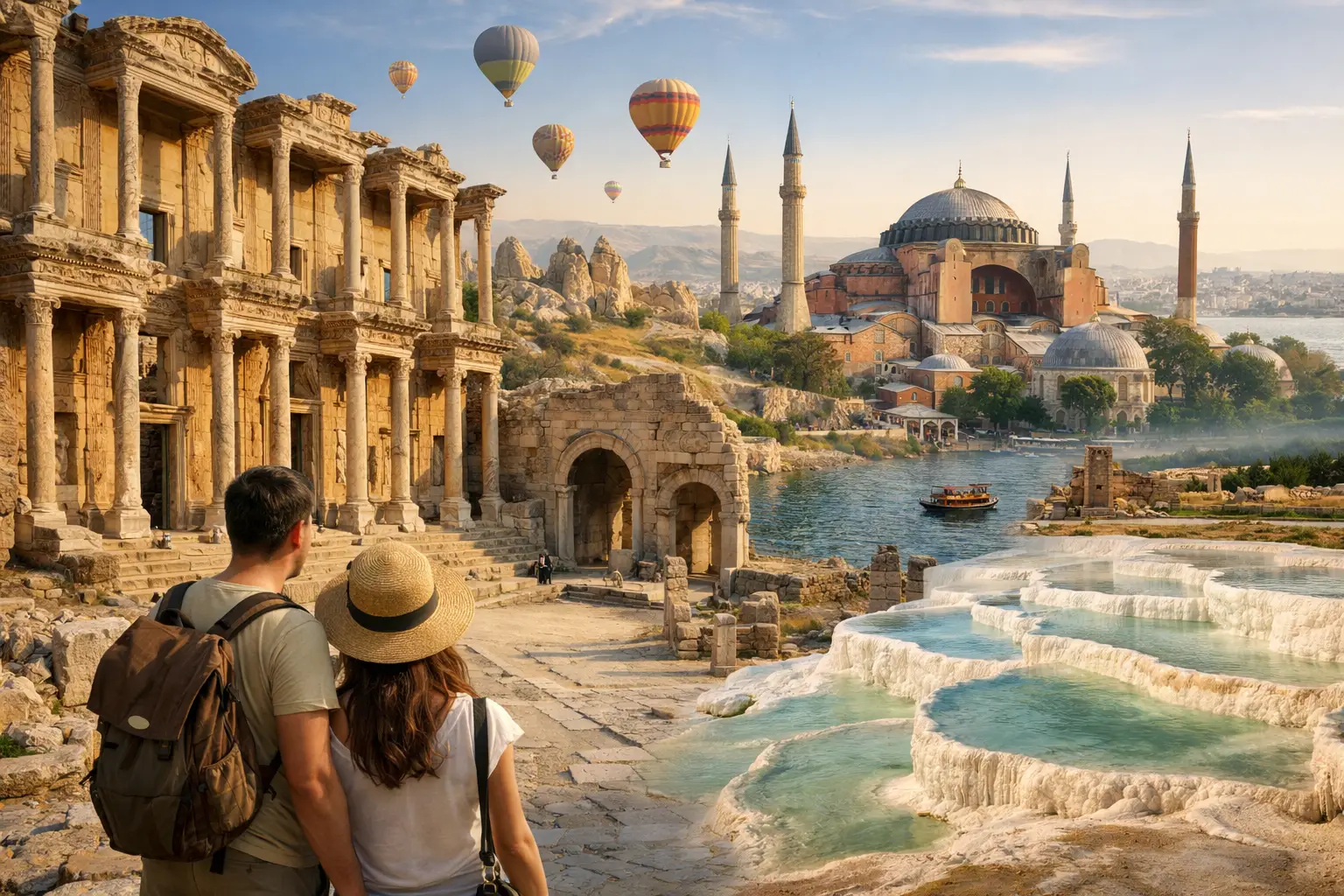
Turkey archaeological tour packages work best when they follow the geography of the ancient world rather than forcing major sites into a rushed checklist. A well-planned journey can connect Istanbul’s museum collections with Troy, Pergamon, Ephesus, Aphrodisias, Hierapolis, and Cappadocia while allowing enough time to understand what makes each place distinct. For travelers crossing an ocean to reach Turkey, that structure matters as much as the sites themselves.
Turkey holds layers of Hittite, Greek, Roman, Byzantine, Ottoman, and Anatolian heritage within relatively manageable travel distances. The challenge is not finding places of archaeological interest. It is choosing the right sequence, pacing the days realistically, and arranging comfortable hotels, road transport, domestic flights, and licensed local guides. Private and small-group tours make this much easier, especially for travelers who want meaningful context without the pressure of large coach schedules.
What to Expect From Turkey Archaeological Tour Packages
A quality archaeological itinerary combines guided site visits with the practical details that make multi-city travel comfortable. This usually includes airport transfers, selected hotels, private transport or a small-group vehicle, domestic flights where they save substantial time, and experienced guides at key locations.
The strongest programs do not treat every ruin the same way. Ephesus rewards a detailed half-day or full-day visit because of its remarkably preserved streets, public buildings, terraces, and surrounding landmarks. Troy is more compact, but its archaeological layers and setting near the Dardanelles deserve thoughtful interpretation. Pamukkale is best paired with the ancient city of Hierapolis, where broad streets, a theater, and a vast necropolis sit above the famous white mineral terraces.
A private Turkey tour also gives you control over the balance. Some travelers want full days on site, with museum stops and unhurried photography. Others prefer a focused morning among the ruins followed by a comfortable afternoon at their hotel, a local meal, or time in a coastal town. Both approaches are valid, and a tailor-made itinerary should reflect how you prefer to travel.
The Most Rewarding Archaeological Route
For a first journey centered on antiquity, a route from Istanbul through the Aegean and into central Anatolia offers the best variety. It combines major classical sites, museum collections, distinctive landscapes, and reliable domestic connections.
Begin in Istanbul for context and collections
Istanbul is a practical arrival point and an excellent introduction to Turkey’s long history. Beyond its celebrated historic districts, the city’s archaeological museums provide valuable context before you visit the sites themselves. Sculptures, inscriptions, sarcophagi, and objects from ancient Anatolia help turn later ruins from impressive stonework into places with human stories.
Two or three nights are usually enough for travelers who want to include a guided city experience before continuing inland. Private Istanbul tours are particularly useful for adjusting museum visits, historic neighborhoods, hotel location, and airport timing around an international arrival.
Add Gallipoli and Troy for a northern Aegean chapter
Travelers interested in early settlement layers and the story of ancient Troy can continue west from Istanbul. Troy is not a reconstructed ancient city, and that is part of its value. Its appeal lies in seeing how a strategic settlement developed through multiple periods on the same ground. A knowledgeable guide is essential here, as the visible remains are best understood through the sequence of excavated layers.
Gallipoli and Troy are often paired in a longer itinerary because they are in the same broader region. This works well if you have at least 10 days, but it can feel compressed on a shorter program. Travelers with seven or eight days may prefer to fly directly from Istanbul to Izmir and concentrate on the central Aegean sites.
Continue to Pergamon, Ephesus, and Aphrodisias
The Aegean coast and inland valleys provide some of the country’s most rewarding archaeological touring. Pergamon rises dramatically above the modern town of Bergama, with an acropolis that reveals the scale and ambition of an ancient hilltop city. Its steep terrain makes it especially memorable, although travelers should be comfortable with uneven walking surfaces.
Ephesus, near Selçuk, is typically the centerpiece of this portion of the trip. The site has an exceptional sense of urban form, from monumental avenues and fountains to houses, baths, and theaters. A private Ephesus tour can be arranged with a morning entrance to avoid the busiest hours, then paired with nearby archaeological points of interest and a relaxed overnight stay in the region.
Aphrodisias is often the favorite surprise for travelers with a deeper interest in archaeology. Located farther inland, it is less crowded than Ephesus and known for its stadium, temple complex, sculpture tradition, and excellent on-site museum. Adding it takes more travel time, so it is best suited to a 10- to 14-day itinerary rather than a fast-paced highlights trip.
Finish at Pamukkale and Cappadocia
Pamukkale offers a rare combination of landscape and archaeology. The white travertine terraces are visually striking, while ancient Hierapolis extends across the plateau above them. Staying overnight nearby allows visitors to experience the site beyond the busiest daytime period and avoids a long same-day drive from the coast.
Cappadocia provides a different archaeological perspective. Its heritage is shaped by volcanic rock, cave settlements, carved dwellings, underground cities, and historic valley landscapes rather than a single Greco-Roman city plan. A two- or three-night stay gives you time for guided Cappadocia tours, a cave hotel experience, and a more relaxed rhythm after several active days among large archaeological sites.
Choosing Private, Small-Group, or Tailor-Made Travel
The best format depends on your priorities. A small-group itinerary is a sensible choice when you want a fixed route, shared transportation, and a social travel experience with fewer planning decisions. It can be especially efficient for classic combinations such as Istanbul, Ephesus, Pamukkale, and Cappadocia.
Private touring is better suited to travelers who want to set the pace. You can spend longer at a museum, schedule a later start after a long flight, select boutique hotels, or make room for a coastal extension in Bodrum, Fethiye, or Antalya. Families, couples celebrating a special occasion, and travelers with specific historical interests often benefit most from this flexibility.
A tailor-made route is also the right answer when site priorities do not fit a standard package. For example, an itinerary focused on Troy, Pergamon, Ephesus, Aphrodisias, and Hierapolis requires a different flow than a trip that places Cappadocia and Istanbul at the center. Domestic flights can reduce long overland transfers, while private vehicles are often the most comfortable way to reach archaeological areas outside major cities.
Practical Planning Tips
April through June and September through October are generally the most comfortable months for archaeological touring. Days are often pleasant for walking, and the light is excellent for photography. July and August can still work well, particularly with early site visits, well-located hotels, and a slower afternoon schedule. Winter is quieter and can be rewarding in Istanbul and the Aegean, though daylight is shorter and some outdoor conditions vary.
Plan a minimum of eight days for Istanbul, Ephesus, Pamukkale, and Cappadocia. Ten to 12 days gives the itinerary a more comfortable pace and makes room for Pergamon, Troy, Aphrodisias, or extra time in Istanbul. For travelers who wish to add a Blue Cruise or a few beach nights, 12 to 15 days is a more natural range.
Bring supportive walking shoes with good grip, a light day bag, sun protection, and a refillable water bottle. Ancient cities involve stone paths, slopes, steps, and little shade in some areas. Guides can tailor the walking pace, but the experience is more enjoyable when your itinerary includes realistic travel times and no unnecessary one-night stops.
Hotel choice also shapes the trip. Boutique stays in Istanbul and Selçuk create a more local feel, while a comfortable hotel near Pamukkale simplifies an early visit to Hierapolis. In Cappadocia, a well-chosen cave hotel adds character without sacrificing practical comforts such as easy access, heating or cooling, and luggage assistance.
The most satisfying archaeological trip is not the one that includes every possible ruin. It is the one that gives you enough time to stand in an ancient theater, follow the line of a marble street, and let a licensed guide explain why that place mattered. Travel Store Turkey can arrange a private or small-group route around your preferred sites, travel dates, hotel style, and pace, so the logistics support the history rather than interrupt it.
0 Comment