
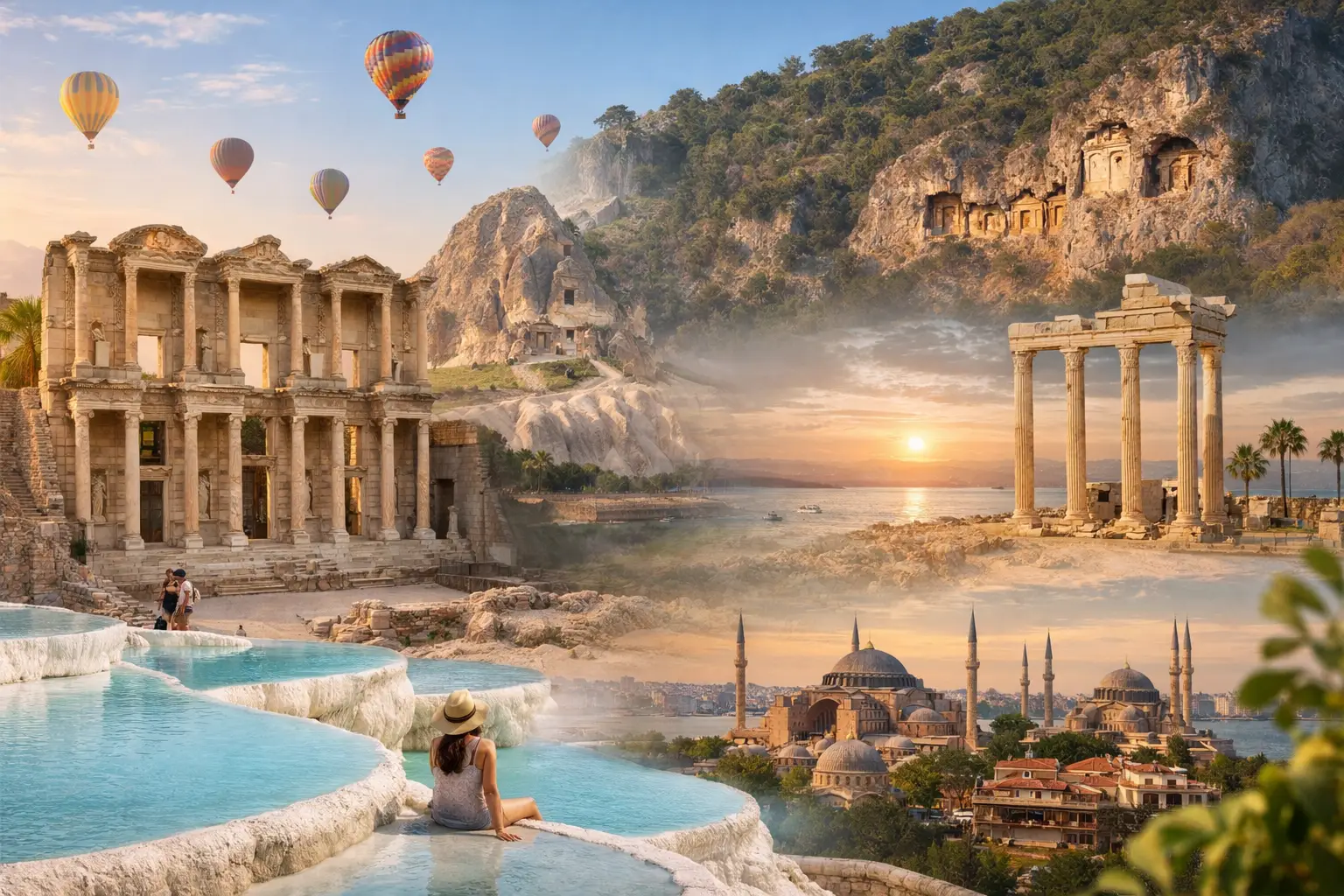
6 Days Turkey Tour: Gallipoli, Troy, Pergamon, Ephesus,
Pamukkale and Cappadocia
Turkey is best experienced as a continuous journey through civilizations,
landscapes and historical turning points. Within a relatively short distance,
travelers can move from the First World War battlefields of the Dardanelles
to the legendary city of Troy, continue through the Hellenistic monuments of
Pergamon and the Roman avenues of Ephesus, then travel inland to the thermal
terraces of Pamukkale and the volcanic valleys of Cappadocia.
Connecting all of these regions independently is possible, but it requires
careful planning. Hotels, ferry crossings, overland transfers, museum opening
hours, domestic flights and airport connections must all work together. A
professionally coordinated
6 Days Turkey Tour
brings the route together in one organized itinerary, allowing travelers to
spend their time exploring rather than managing transportation logistics.
A Complete Journey Through Western and Central Turkey
This itinerary is designed for travelers who want to see more than the usual
combination of Istanbul and Cappadocia. It follows one of Turkey’s richest
historical corridors, beginning around the Dardanelles and continuing south
through the Aegean region before reaching Central Anatolia.
What makes the route particularly rewarding is the variety of experiences
included within a single journey. Gallipoli introduces the modern history of
Turkey and the events of the 1915 campaign. Troy connects the archaeological
record with the stories of Homer. Pergamon represents the intellectual and
architectural achievements of the Hellenistic world, while Ephesus offers an
exceptionally detailed picture of life in a prosperous Roman city.
The journey then changes character in Pamukkale, where ancient thermal culture
meets one of Turkey’s most recognizable natural formations. Cappadocia provides
a dramatic final chapter with its fairy chimneys, cave churches, underground
settlements and optional sunrise balloon flights.
Although six days is an active schedule, the combination of private transfers,
carefully selected hotels and domestic flights makes it possible to cover the
route efficiently. Travelers who prefer a slower pace can easily extend the
program with additional nights in Cappadocia, Kuşadası, Pamukkale or Istanbul.
Gallipoli: The Beginning of the Journey
The route usually begins with an early departure from Istanbul toward the
Gallipoli Peninsula. The drive follows the European side of the Sea of Marmara
before reaching the Dardanelles, one of the most strategically important
waterways in world history.
Gallipoli is not simply a battlefield visit. It is a landscape of memorials,
cemeteries, former trenches and ridgelines where the geography itself explains
many of the decisions and difficulties of the 1915 campaign. Visiting with a
knowledgeable guide provides the historical background needed to understand
the experiences of the Ottoman, Australian, New Zealand, British and French
forces who fought here.
The guided route commonly includes Brighton Beach, ANZAC Cove, Arıburnu
Cemetery, Lone Pine, Johnston’s Jolly, The Nek and Chunuk Bair. Each location
represents a different part of the campaign, from the original landings to the
battles fought for control of the peninsula’s high ground.
For travelers from Australia and New Zealand, Gallipoli often has strong family
and national significance. For other visitors, it offers a deeper understanding
of the final years of the Ottoman Empire and the historical circumstances that
contributed to the foundation of the Turkish Republic.
Travelers with additional time can also consider a separate
2 Days Gallipoli and Troy Tour from Istanbul
,
which allows more time for both the battlefield sites and the archaeological
remains of Troy.
Troy: Archaeology, Myth and the Dardanelles
After visiting Gallipoli, the journey crosses the Dardanelles toward Çanakkale
and the ancient region once known as the Troad. This area occupies a special
place in both archaeology and literature because it is associated with Troy,
the Trojan War and Homer’s Iliad.
The ancient city developed over thousands of years, and the ruins visible today
belong to several different settlement periods. Archaeologists identified a
succession of cities built one above another, each reflecting different phases
of occupation, destruction and reconstruction.
During a guided visit, travelers see sections of the defensive walls, gateways,
ramps, sanctuary areas, houses and Roman-period structures. The archaeological
layers help explain why Troy is more complex than the familiar story of Helen,
Paris, Achilles and the wooden horse.
The site is especially interesting because it stands between mythology and
historical evidence. While the stories of the Trojan War were shaped through
centuries of oral and literary tradition, excavations confirmed that a major
fortified settlement existed in the region during the Bronze Age.
Depending on the daily schedule, the Troy Museum may also be added. Its
collections provide valuable context through pottery, sculptures, architectural
pieces, jewelry and objects discovered across the Troad.
Our detailed
Gallipoli and Troy travel guide
provides further information for travelers who want to explore this historic
region as a separate journey.
Pergamon: A Hilltop Capital of the Hellenistic World
From Troy, the route continues south through the landscapes of western Turkey
toward Bergama, the modern town located below ancient Pergamon. During the
Hellenistic period, Pergamon developed into one of the most influential kingdoms
of the ancient Mediterranean.
Its rulers transformed the hilltop acropolis into a major political, religious
and cultural center. The city became known for monumental architecture, medical
learning, artistic production and a famous library that was considered one of
the greatest collections of the ancient world.
The remains of the acropolis include the Temple of Trajan, the foundations of
the Altar of Zeus, the Temple of Athena, parts of the library and an extraordinary
theater built into the steep hillside. The theater’s location creates a dramatic
view across the valley and helps visitors understand the scale and ambition of
Pergamon’s urban design.
Pergamon is sometimes overlooked by travelers moving directly between Troy and
Ephesus, but it is one of the most important sites on the route. It provides a
clear transition between the Bronze Age history of Troy and the later Greek and
Roman world represented by Ephesus.
Travelers with a particular interest in ancient medicine may also add the
Asklepion, located below the acropolis. This sanctuary developed into an
important healing center where treatments included bathing, exercise, diet,
dream interpretation and therapeutic rituals.
Ephesus: Walking Through a Roman Metropolis
The journey continues toward Selçuk and Kuşadası, the main bases for visiting
Ephesus. Among all the archaeological sites in Turkey, Ephesus offers one of the
clearest impressions of how a major Roman city was organized and experienced.
Visitors do not simply view isolated ruins. They walk through streets lined with
fountains, temples, baths, public buildings and private residences. The surviving
monuments reveal how religion, politics, trade, entertainment and domestic life
were connected within the ancient city.
A typical guided route begins near the upper entrance and follows Curetes Street
past the remains of the State Agora, the Odeon, the Fountain of Trajan and the
Temple of Hadrian. The street eventually reaches the Library of Celsus, the most
famous monument at Ephesus and one of the best-known surviving façades from the
Roman world.
From the library, the route continues toward the Commercial Agora and the Great
Theater. With seating for thousands of spectators, the theater demonstrates the
size and importance of Ephesus during the Roman period.
The Terrace Houses can be included for travelers who want a closer look at
private life in the city. These residences contain mosaics, frescoes, marble
interiors and advanced systems of heating and water management. They provide a
valuable contrast to the public monuments found along the main streets.
Most
guided Ephesus tours
also include the House of the Virgin Mary and the remains of the Temple of
Artemis. Depending on the interests of the travelers, the Basilica of Saint John,
İsa Bey Mosque or the village of Şirince may also be added.
Because Ephesus contains so many layers of history, the quality of the guide makes
a significant difference. A licensed local guide can explain not only the names
of the monuments but also how the city functioned, why its harbor declined and
how Ephesus became important within both Roman and early Christian history.
Pamukkale and Hierapolis: Thermal Waters and Ancient History
From the Aegean coast, the route turns inland toward Pamukkale. The landscape
changes gradually as the journey moves away from the coastal plains and toward
the valleys of Denizli Province.
Pamukkale is famous for the white mineral terraces that descend from the hillside.
For thousands of years, warm water rich in calcium has flowed across the slope,
gradually creating pools, channels and brilliant white travertine formations.
The natural terraces are only one part of the visit. Above them lies Hierapolis,
an ancient city established around the thermal springs. The settlement became
known as a place of healing, bathing and religious importance during the
Hellenistic and Roman periods.
The archaeological area includes a large theater, the Temple of Apollo, the
Plutonium, Roman baths, monumental gates, ancient streets and one of the most
extensive necropolises in Turkey. The variety of tombs demonstrates that people
traveled to Hierapolis from across the ancient world, often seeking treatment
from the thermal waters.
Visitors can walk barefoot through designated sections of the travertines and,
when operating conditions allow, swim in the Antique Pool, commonly known as
Cleopatra’s Pool. The pool contains warm thermal water and ancient architectural
fragments that fell into it over the centuries.
For travelers focusing only on the Aegean region, the
2-Day Ephesus and Pamukkale Tour from Istanbul
combines these two major destinations with domestic flights, transfers,
accommodation and guided sightseeing. :contentReference[oaicite:1]{index=1}
Cappadocia: The Final Chapter of the Route
After exploring Pamukkale, the journey continues to Cappadocia. Depending on the
season and airline schedule, this section may involve a direct regional flight,
a connection through Istanbul or a carefully planned combination of airport and
road transfers.
Cappadocia feels entirely different from the destinations visited earlier in the
itinerary. Its landscape was formed by volcanic deposits that were gradually
shaped by wind and water into valleys, cones, ridges and fairy chimneys.
Generations of local communities carved homes, monasteries, churches, storage
rooms and underground shelters into the soft volcanic rock.
The Göreme Open Air Museum is one of the region’s essential historical sites. Its
rock-cut churches contain Byzantine frescoes depicting scenes from the life of
Christ, saints and biblical narratives. The complex reflects the importance of
Cappadocia as a center of Christian monastic life.
A northern Cappadocia route may include Uçhisar, Paşabağ, Devrent Valley, Avanos
and the Göreme area. A southern route normally focuses on an underground city,
panoramic valleys and villages shaped by the region’s distinctive geology.
Underground cities are among Cappadocia’s most unusual attractions. These
multi-level complexes include ventilation shafts, kitchens, storage rooms,
passageways, wells and defensive stone doors. They were designed to shelter
communities during periods of insecurity.
Many travelers also choose an optional sunrise hot-air balloon flight. When
weather conditions and aviation authorities permit, balloons rise above the
valleys shortly after sunrise, creating wide views across the volcanic landscape.
Balloon operations are always dependent on weather and cannot be guaranteed,
which is why spending at least two mornings in Cappadocia is preferable whenever
the schedule allows.
Travelers who want to visit Cappadocia separately can explore our
2 Days Cappadocia Tour from Istanbul
,
including transfers, regional touring and cave-hotel accommodation options.
:contentReference[oaicite:2]{index=2}
Can the Tour Operate in Reverse?
One of the most important advantages of this itinerary is that it can operate
in either direction. The correct order should not be decided by appearance
alone; it should be based on the most efficient flight schedules available for
the selected dates.
In the standard direction, travelers leave Istanbul by road and continue through
Gallipoli, Troy, Pergamon, Ephesus and Pamukkale before flying or transferring
to Cappadocia. The tour then finishes with a flight from Cappadocia back to
Istanbul.
Istanbul → Gallipoli → Troy → Pergamon → Ephesus → Pamukkale →
Cappadocia → Istanbul
In the reverse direction, travelers fly from Istanbul to Cappadocia at the
beginning of the journey. After touring Cappadocia, they continue west toward
Pamukkale and Ephesus, then travel north through Pergamon, Troy and Gallipoli
before returning to Istanbul.
Istanbul → Cappadocia → Pamukkale → Ephesus → Pergamon → Troy →
Gallipoli → Istanbul
This flexibility is especially useful because direct flights between Cappadocia,
İzmir and Denizli do not operate with the same frequency throughout the year.
Building the program around real flight availability prevents unnecessary
overnight connections, long airport waits and lost sightseeing time.
Small-Group or Private Tour: Which Option Is Better?
The route can be arranged as either a small-group program or a completely private
journey. The most suitable option depends on budget, travel style, group size and
the amount of flexibility required.
A small-group tour is often the more economical choice for solo travelers,
couples and friends who are comfortable sharing guided sightseeing and regional
transfers with other guests. It still provides organized hotels, transportation,
domestic flights and professional guiding, but the daily timetable follows the
group schedule.
A private tour offers significantly more control. Departure times, hotel
categories, room types, lunch breaks, sightseeing pace and optional visits can
all be adjusted according to the travelers’ preferences. This is particularly
valuable for families, senior travelers, archaeology enthusiasts, photographers
and groups who want to spend more time at specific sites.
Travel Store Turkey offers both the
6 Days Turkey Tour small-group program
and a
6-Day Private Turkey Tour
.
The private version is designed around the travelers’ own pace and includes
private transportation and personalized guiding. :contentReference[oaicite:3]{index=3}
What Is Usually Included?
The exact inclusions depend on whether the program is booked as a private or
small-group tour, but a complete multi-region package is designed to combine the
essential travel services under one reservation.
A typical package may include hotel accommodation with breakfast, professional
licensed guides, air-conditioned transportation, airport transfers, domestic
flight tickets, ferry crossings, sightseeing tours and the entrance fees clearly
listed in the confirmed itinerary.
Private programs normally use a dedicated vehicle for the travelers throughout
each touring section. Small-group programs may use shared airport transfers and
regional tours, depending on the final package description.
Lunches may be included on selected guided touring days, while dinners, drinks,
personal expenses, gratuities and optional activities are usually excluded unless
they are specifically listed in the quotation.
Because every package can be structured differently, travelers should always
review the final inclusion and exclusion list rather than assuming that all
domestic flights, meals or entrance fees are automatically included. Our guide
explaining
what is included in Turkey tours
provides additional information about hotels, transfers, flights, meals and
optional services. :contentReference[oaicite:4]{index=4}
Hotels Along the Route
Accommodation plays an important role in a fast-moving itinerary. Hotels should
not be selected only according to their star category; location, check-in
efficiency, breakfast times and distance from the next day’s route are equally
important.
In Çanakkale, centrally located hotels make it easier to cross the Dardanelles
and continue toward Troy. In the Ephesus region, travelers may stay in Kuşadası,
Selçuk or Şirince depending on whether they prefer the coast, proximity to the
archaeological sites or a quieter village atmosphere.
Pamukkale offers both standard hotels and thermal properties with indoor and
outdoor pools. Cappadocia provides traditional stone hotels, boutique properties
and cave rooms carved into the region’s volcanic formations.
Private tours can be priced with different hotel categories. Travelers may choose
practical four-star properties, premium centrally located hotels or luxury cave
suites. The final selection should reflect both the budget and the style of the
journey.
Is Six Days Really Enough?
Six days is enough to complete this circuit when the transportation plan is built
carefully and the travelers are comfortable with an active itinerary. It is not,
however, a slow holiday. Several days involve early departures, long-distance
transfers or evening flights.
The itinerary works best for travelers who want to see a large number of major
historical destinations within a limited period. It is particularly suitable for
first-time visitors, archaeology enthusiasts and travelers combining Turkey with
another country or a cruise.
Those who prefer leisurely breakfasts, free afternoons and longer hotel stays
should consider extending the program to seven or eight days. One additional
night can make a significant difference, especially in Cappadocia or the Ephesus
region.
Travelers with even more time may combine the same historical corridor with
Istanbul sightseeing, Antalya, a coastal stay or a private gulet cruise.
Best Time to Take This Tour
The route can operate throughout the year, but spring and autumn generally provide
the most comfortable conditions for archaeological sightseeing. April, May, late
September and October usually offer moderate temperatures in Gallipoli, Ephesus,
Pamukkale and Cappadocia.
Summer provides long daylight hours but can be hot, particularly at Troy,
Pergamon, Ephesus and Pamukkale. During July and August, early departures, sun
protection and sufficient water are essential.
Winter offers quieter archaeological sites and lower seasonal demand, although
weather conditions can affect road travel and balloon operations in Cappadocia.
Travelers should also expect shorter daylight hours and colder mornings.
Spring and autumn are also the most popular seasons, so hotels, domestic flights
and Cappadocia balloon reservations should be confirmed in advance.
Practical Planning Advice
Luggage should be kept manageable because the journey includes several hotel
changes and may include domestic flights with specific baggage allowances.
Travelers should check the confirmed ticket conditions before departure rather
than relying on international flight allowances.
Comfortable walking shoes are essential. Troy, Pergamon, Ephesus, Hierapolis and
Cappadocia all include uneven surfaces, stone pathways and exposed archaeological
areas. A light jacket is useful even in warmer months because morning temperatures
in Cappadocia can be significantly cooler than those on the Aegean coast.
Travelers should also remember that historical sites are not museums with
completely controlled environments. Weather, restoration projects, local
regulations and opening hours may occasionally require adjustments to the order
of visits.
Booking through an experienced local tour operator allows these details to be
handled as part of the journey. When flight times or operating conditions change,
the itinerary can be rearranged without leaving the traveler to coordinate each
supplier independently.
Frequently Asked Questions
Does the tour start and finish in Istanbul?
Most versions begin and finish in Istanbul. The route can also be adapted for
travelers arriving in Çanakkale, İzmir, Denizli, Cappadocia or another Turkish
city.
Can the itinerary run from Cappadocia to Gallipoli?
Yes. The complete route can operate in reverse when westbound domestic flights
and regional connections provide a more efficient schedule.
Is the tour suitable for senior travelers?
It can be suitable for active senior travelers, particularly when arranged
privately. A private vehicle allows more flexible departure times, rest stops
and sightseeing duration. Travelers with mobility limitations should discuss
the walking conditions before booking.
Is the Cappadocia balloon flight included?
The balloon flight is usually an optional activity unless it is specifically
listed as included. Flights depend on weather conditions and aviation approval.
Are all entrance fees included?
Entrance fees are included only when they are listed in the final confirmed
itinerary. Optional areas such as the Ephesus Terrace Houses, Cleopatra’s Antique
Pool or specific museums may be priced separately.
Can we choose our own hotels?
Yes. Private and tailor-made programs can be prepared with different hotel
categories, locations and room types according to the travelers’ budget and
preferences.
Can extra nights be added?
Yes. Extra nights can be added in Istanbul, Çanakkale, Kuşadası, Pamukkale or
Cappadocia. Extending the journey is recommended for travelers who prefer a
slower pace.
Plan Your Complete Turkey Cultural Journey
A journey through Gallipoli, Troy, Pergamon, Ephesus, Pamukkale and Cappadocia
brings together some of Turkey’s most important historical and natural
destinations. The route crosses thousands of years of history, from Bronze Age
settlements and Hellenistic kingdoms to Roman cities, Byzantine churches and
the battlefields of the twentieth century.
The success of the journey depends on more than choosing the right places.
Transportation times, hotels, domestic flights, guides and entrance arrangements
must all be coordinated carefully. When these details are planned properly, even
an ambitious six-day circuit can feel organized and rewarding.
Travel Store Turkey can arrange the program as a scheduled small-group departure
or as a fully private itinerary. Hotels, room categories, tour direction,
optional activities and the number of nights can all be adjusted according to
your travel dates and personal interests.
Explore the Full Tour Program
Review the day-by-day itinerary, included services and available tour options
for this complete journey through western and central Turkey.
0 Comment